


AI-assisted microscopy reveals how nanowires grow atom-by-atom inside carbon nanotubes
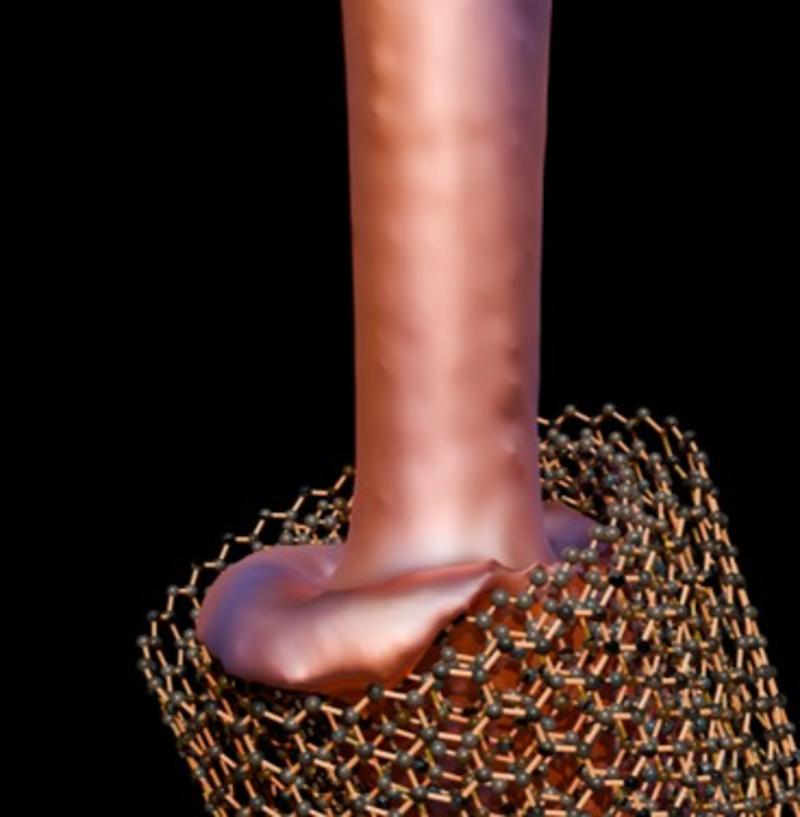
A graphical illustration of the liquid-phase growth of nanowires within the combined core of a multi-walled carbon nanotube
"This discovery resolves a long-standing challenge in nanomaterial synthesis: understanding how confined nanowires actually form."
Professor Nicole Grobert
Researchers at the Nanomaterials by Design group based in this department have directly visualised how metals wet carbon surfaces at the atomic scale, capturing for the first time the liquid growth of nanowires formed from vapour-phase encapsulation.
Using in situ transmission electron microscopy (TEM), which allows atoms to be directly observed in real-time, the researchers recorded the dynamic wetting behaviour of nanowires within multi-walled carbon nanotubes (MWCNTs), revealing how vapour condenses to form nanowires and drives growth within the confined MWCNT core.
The study, published in Nature Communications, was co-led by George Tebbutt and Professor Nicole Grobert from this department, in collaboration with Dr Christopher Allen (Principal Scientist at the electron Physical Science Imaging Centre (eSIC) at Diamond Light Source), and Professor Anna Fabijanska (Lodz University of Technology).
The project brought together expertise in nanomaterials synthesis, in situ electron microscopy, and artificial intelligence, combining advanced experimental techniques with computational analysis to achieve a complete picture of the growth mechanism across scales.
Seeing wetting as it happens
When materials form inside carbon nanotubes, their behaviour is fundamentally altered by nanoscale confinement, yet despite decades of research, it had remained unclear why some vapour-phase precursors formed continuous encapsulated nanowires, while others failed. In this work, the researchers reveal that nanowire formation proceeds through a two-stage mechanism:
- curvature-driven nucleation near open nanotube ends, followed by:
- capillary-driven elongation sustained by continuous vapour condensation.
Crucially, growth requires a favourable wetting interface between liquid nanowires and the nanotube wall (a contact angle 0<90 degrees), a condition not captured by classical equilibrium models.
"Wetting controls everything from how water moves through nature capillaries to how metal oxides grow inside the core of CNTs" said George Tebbutt, the first author of the paper. "Seeing it happen atom-by-atom in real-time changes how we understand and fabricate advanced materials".
Turning atomic-scale data into physical insight
Recording these dynamics at atomic resolution generated vast datasets containing thousands of TEM frames. To interpret this 'atomic-scale big data', the team developed a deep-learning framework capable of automatically segmenting and analysing in situ microscopy videos, enabling high-throughput measurements of contact angles, the nanowire growth front, and interfacial changes.
Our framework turns potentially terabytes of imaging data into quantitative physical insight - transforming how we study structure-property relationships at the smallest scales.
Why it matters
The findings show that classical models such as the Kelvin and Lucas-Washburn equations (used to describe condensation and capillary infiltration) cannot explain nanowire formation under confinement. Instead, the process follows a dynamic, non-equilibrium pathway involving vapour adsorption, liquid meniscus formation, and capillary-driven elongation, revealing how wetting evolves in real time at the atomic level. Professor Nicole Grobert commented that this discovery
"... shows that wetting is not static, but dynamically governs how vapour-phase materials transform and nanowires grow. This insight opens new opportunities for the scalable manufacture of these advanced materials."
Nanowires are ultra-thin crystals with remarkable electrical, optical, and quantum properties. When encapsulated in carbon nanotubes, they exhibit exceptional stability and conductivity, offering potential applications in energy storage, quantum computing and nanoelectronics.
By uncovering the atomic-scale mechanisms driving their growth, this research advances the development of next-generation nanomaterials and supports the Engineering and Physical Sciences Research Council (EPSRC) missions in Advanced Materials for the Future, AI for Real Data, and Manufacturing for the Future, which aim to harness artificial intelligence and data-driven approaches for sustainable materials innovation.

