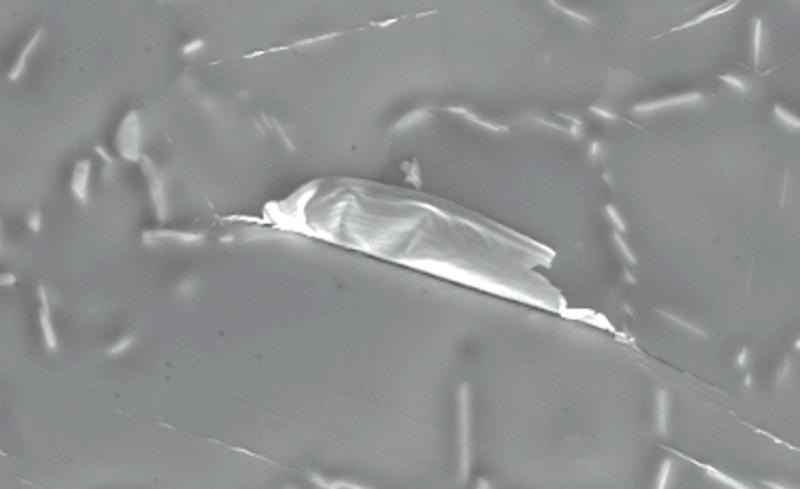
In the (very) high cycle fatigue regime crack initiation and short fatigue crack growth dominate fatigue lives. We have developed novel ultrasonic methods for very rapid (~106 cycles in <1 min) fatigue testing of very small (~0.5 to 200 µm across) material volumes cut by either FIB or laser micro-machining. Focussing the testing down to a small region allows the progression of deformation to be followed in detail for which a range of characterisation methods will be used.
This project will focus on the limited and highly localised deformation that occurs prior to crack initiation. Secondary electron imaging in SEM will allow assessment of slip feature development and eventual crack formation. Digital image correlation (DIC) will be used to quantify localised slip features which will be related to the underlying crystallography revealed by EBSD which also map intra-granular distributions of local stress and dislocation density. Electron channelling contrast for imaging dislocations may also be used. The experimental programme will be linked to some crystal plasticity FEA simulations.
This project will explore use of laser micro-machining (or possibly plasma-FIB) to cut free standing cantilevers in targeted locations on the surface of bulk samples. This would offer a significant step forward with sample preparation which has previously cut through thickness of thin foils which a time consuming and difficult to make.