


Lithium-ion batteries: interplay between stack pressure, mechanical expansion & degradation pathways
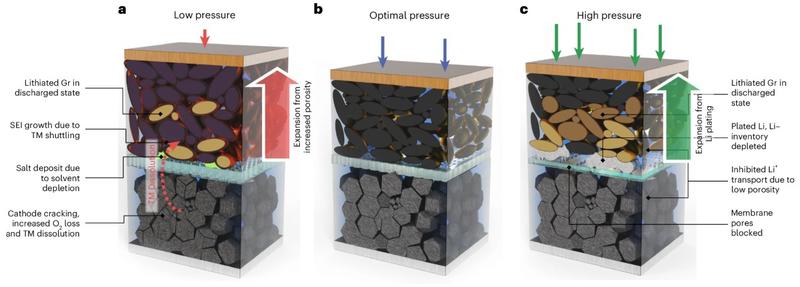
In the paper 'The interplay between stack pressure, mechanical expansions and degradation pathways in lithium-ion batteries' (published in Nature Energy), Dr Erik Bjorklund and Professor Rob Weatherup of this department, together with researchers from The Faraday Institution, the University of Cambridge, the University of Sydney and the University of Warwick review the influence of mechanical factors in degradation mechanisms in lithium-ion batteries.
They introduce a high-precision stack-pressure control and dilatometry tool to apply a uniform and constant stack pressure on electrodes independent of electrode swelling. They explain that increasing the stack pressure fourfold over typical initial batteries doubled the lifetime of graphite IILiNi0.8Mn0.1VCo0.1O2 cells without altering active materials or electrolytes, which suggests a wider sub-optimal stack pressure condition.
In this paper the authors demonstrate that different degradation mechanisms emerge outside the optimal pressure window. They explain how low stack pressure accelerates cathode cracking, whereas high pressure promotes lithium plating, and therefore they suggest stack-pressure optimisation as a practical solution for increasing cycling stability.

