

PSG002 - Next generation solvent-free manufacturing of sustainable battery electrodes
Slurry casting is the manufacturing technology underpinning the modern Li-ion battery gigafactory, operating at manufacturing yields of >99% and electrode production speeds of >90 m min⁻¹. However, slurry casting of battery cathodes consumes large quantities of solvent to dissolve polymer binder, followed by energy-intensive drying and solvent recovery, even though the solvent plays no useful role in the battery.
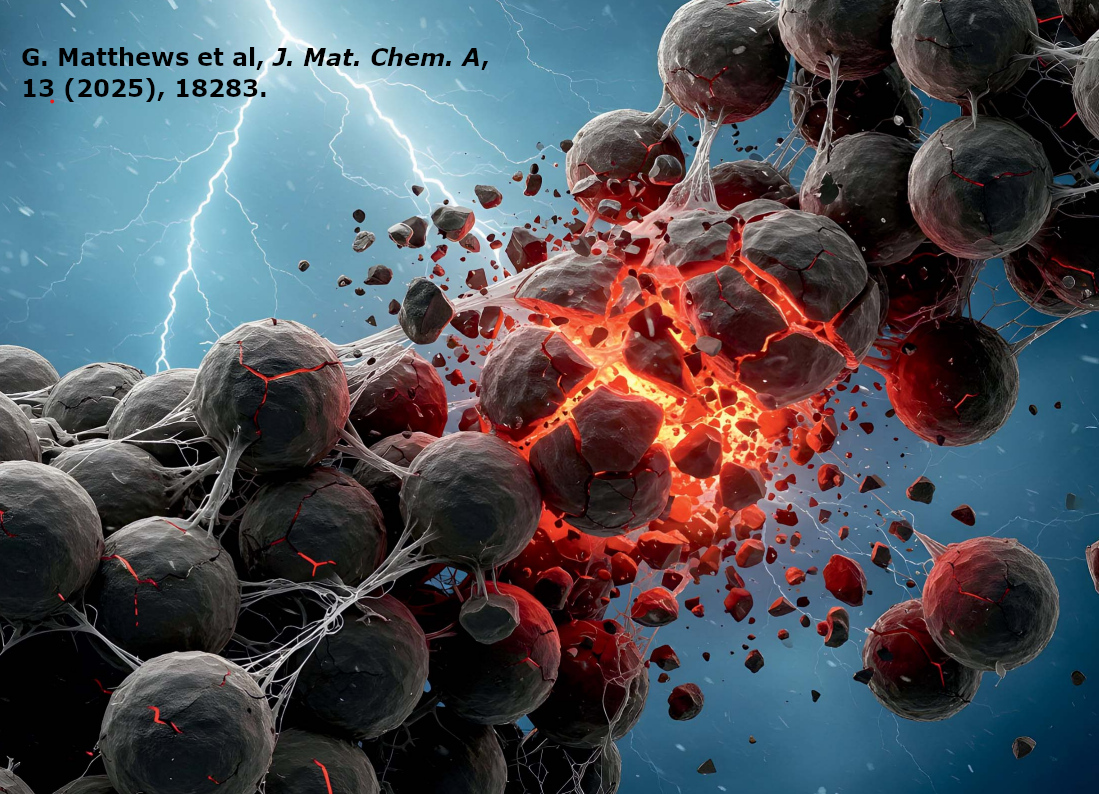
Emerging solvent-free technologies offer an exciting alternative. Rather than dissolving the binder, dry processing mechanically shears polymer between the active particles to form bridges and fibrils that provide mechanical stability. Eliminating solvent removes large drying ovens and solvent-recovery infrastructure, reducing cost, energy consumption and carbon footprint. But eliminating solvents does not itself make electrode manufacturing sustainable. The leading dry binder, PTFE, is readily fibrillated but is a fluorine-containing PFAS polymer of environmental concern. Therefore there is an opportunity to understand why some polymers perform effectively as dry binders and to develop more sustainable alternatives.
However, despite its importance, the behaviour of the polymer binder is a surprisingly poorly understood. Binder typically comprises < 5 wt% of an electrode; nonetheless, its spatial distribution, particle coverage, fibril size and morphology strongly influence electrode manufacture and mechanical integrity. Quantifying these characteristics in realistic electrode microstructures remains challenging. Conventional electron microscopy and X-ray tomography can damage the polymer, lack sufficient adsorption or other contrast between electrode components, or lack the required combination of sensitivity, spatial resolution and sampling volume. So, for example, the degree of active particle surface dry binder coating and its effect surface processes such as Li+ intercalation or the formation of solid electrolyte interphase (SEI) are unknown.
This project will investigate how to exploit and extend new approaches developed in Oxford for selectively labelling and visualising polymer binders within battery electrodes. Recent work using aqueous Ag and gaseous Br reactions has revealed previously unresolved details of particle–binder interactions in both laboratory and commercial Li-ion battery anodes. The project will develop these approaches for the incumbent and emerging dry binders, using two-dimensional mapping, electron imaging of binder nano-layers.
Characterisation will be combined with mechanical and thermophysical studies of binders in bulk, within electrodes and as free-standing networks to establish the links between binder chemistry, fibrillation, and tension-carrying capability and deformation during calendering.
This project would suit a student excited by manufacturing science and the links between processing, microstructure and performance.