


The hidden materials that could unlock the next generation of solar panels
'Solar energy will become one of the world's largest sources of electricity over the coming decade. If we want to build the next generation of yet higher efficiency, more reliable, and better cost solar panels at the scale needed to tackle climate change, we must ensure they rely on materials that are abundant and sustainable as well as high-performing. Our work presents a realistic roadmap for achieving this'.
Professor Ruy Sebastian Bonilla
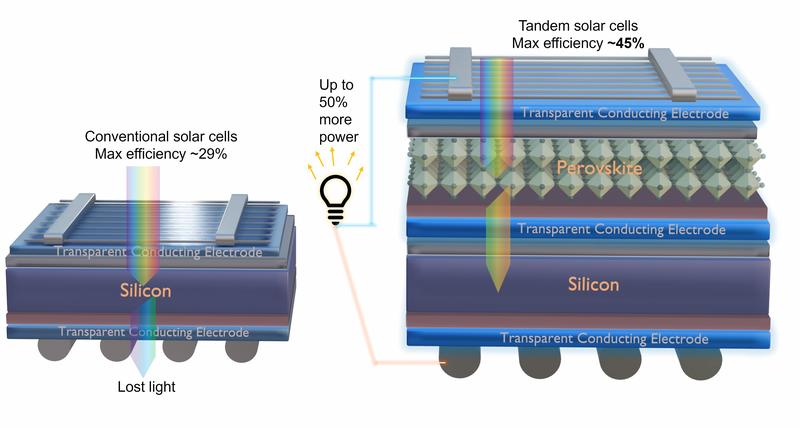
As the world rapidly expands solar power, researchers are racing to develop the next generation of solar cells. Conventional silicon solar cells are becoming more efficient every year, but they are approaching their fundamental efficiency limit of around 29%. Perovskite-silicon tandem solar cells can overcome this limit by stacking two light-absorbing materials together, allowing them to capture more sunlight and generate substantially more electricity. In just over a decade, laboratory efficiencies have increased from below 14% to over 35%, making tandem solar cells the world's most efficient low-cost solar cells.
The next challenge is no longer just about improving tandem cell efficiency, but achieving multi-decade stability, and manufacturing at the enormous scale needed for the global transition to clean energy. A new review (the Review) led by the Bonilla Lab identifies one of the most important components that will determine whether this is possible: transparent conducting electrodes.
Published in Nature Review Physics, the Review analysed the stringent requirements of transparent conductors in tandem solar cells. Transparent conducting electrodes perform several deceptively diffuclt tasks: they act like invisible electrical wires, allowing sunlight into the solar cell while simultaneously collecting and transporting electrical current. That current is the electricity used to power homes, charge electric vehicles, and reduce electrical bills. If these transparent conductors block too much light or current flow, the power output of the solar panels is reduced. Conventional silicon panels often contain one or two of these transparent conducting electrode layers, but tandem solar cells require three, each performing multiple optical and electrical functions simultaneously. As efficiencies continue to improve, even tiny losses at each layer accumulate, making transparent conductors one of the key factors limiting future device performance.
The role of transparent conducting electrodes in tandem solar cells
By improving transparent conductors, tandem cells could some day produce 50% more power than conventional solar panels, and become a major source of global electricity generation.
The authors of the Review, being researchers from the departments of Materials and Chemistry at the University of Oxford, together with collaborators from Australia, France and the Netherlands, identified an important gap in how transparent conductors are currently evaluated for tandem cells. Transparent conductors are typically compared using simple 'figure of merit' metrics based only on electrical conductivity and optical transparency. The Review shows that these measures are no longer sufficent and may be holding back the development of appropriate materials. The ideal properties of transparent conductors depend strongly on position in the tandem cell and can include charge transport between many different layers at once, blocking migrating ions and moisture, transparency to a broad range of light energies, and the ability to be manufactured at low temperatures. The authors argue that future transparent conductors must therefore be designed as part of the complete solar-cell architecture rather than as standalone materials.
Dr John O'Sullivan, EPSRC IAA Doctoral Prize Fellow at the Bonilla Lab, is the first author, supervised by Professor Ruy Sebastian Bonilla. The demanding requirements of transparent conductors for tandem cells have severely limited the number of suitable materials that can be used. To date, the only materials that can perform all necessary roles contain indium, a highly scarce metal. This work estimates that global indium availability and completion from the display industry could limit manufacturing capacity of tandem solar cells to less then 200 gigawatts per year. To put this in context, that is about 20 times less than the solar deployment that is expected to be necessary to meet global climate targets. In other words, current transparent conductors may limit the manufacturing scale ultimately required. The Review therefore highlights the urgent need to develop alternative transport conducting materials that combine high performance with abundant, sustainable, materials.
Fortunately, the researchers believe the challenge is not insurmountable. The Review identifies several promising sustainable alternatives, including new metal oxides, low-temperature processing strategies and emerging nanomaterials that could eliminate the need for indium. They also argue that future progress will require close integration between computational materials discovery, experimental materials science and photovoltaic device engineering so that promising materials are rapidly translated into complete devices.
Transparent conductors are becoming one of the most important components in tandem solar cells. As efficiencies continue to increase, these materials increasingly set limits on their ultimate efficiency as well as how many we can physically manufacture each year. The future scalability of tandem solar cells will depend on the rapid development and the testing of new materials in real cells to understand interfacial loss mechanisms and degradation routes'
Dr John O'Sullivan
Although tandem cells have reached 35% in little over a decade, the authors are confident that we are just scratching the surface of what this new solar cell design can deliver. By identifying the materials challenges facing transparent conducting electrodes, and the most promising routes to overcome them, the Review provides a roadmap towards high-efficiency tandem solar cells that can be manufactured at the scale needed to support the global transition to clean energy.
Read the Review in Nature Review Physics: 'Transparent conducting electrodes for perovskite-silicon tandem solar cells'.

