


Non-equilibrium ion transport in a hybrid battery material
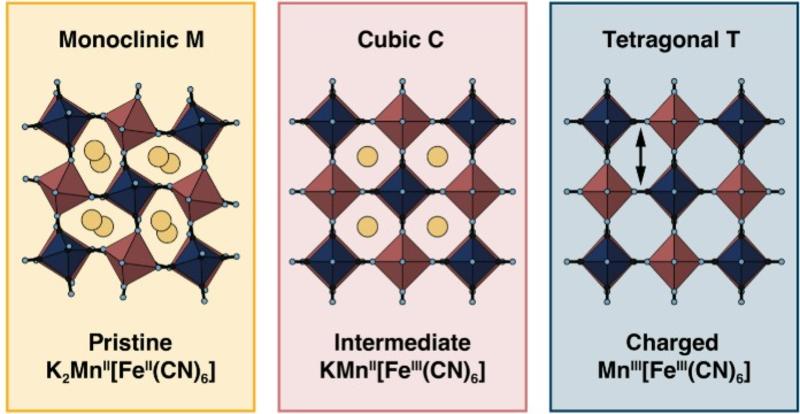
Hybrid materials, which combine inorganic and molecular components, often exhibit structural flexibility that enables unusual functional responses. Among them, Prussian Blue Analogues (PBAs) are a promising class for post-lithium battery technologies.
In the paper 'Nonequilibrium ion transport in a hybrid battery material' published in Science Advances, the authors demonstrate that non-equilibrium transformation processes govern the charge-storage mechanism of a PBA electrode, K2Mn[Fe(CN)6]. Ostensibly, this behaviour mirrors that observed in high-rate cycling of conventional cathodes (such as LiFePo4), yet arose during the research behind this paper for fundamentally different reasons: namely, low-elastic moduli and co-operative distortions inherent to the hybrid framework.
Using operando x-ray absorption spectroscopy with Metropolis matrix factorisation and x-ray diffraction, the authors were able to demonstrate that framework flexibility limits transport kinetics and promotes collective, metastable, pathways. The results not only highlight various directions for PBA cathode optimisation, but also suggest a broader relevance of non-equilibrium mechanisms for mass transport in hybrid materials beyond PBAs alone.

