

Defect-assisted refinement of nanoscale alpha in titanium alloys
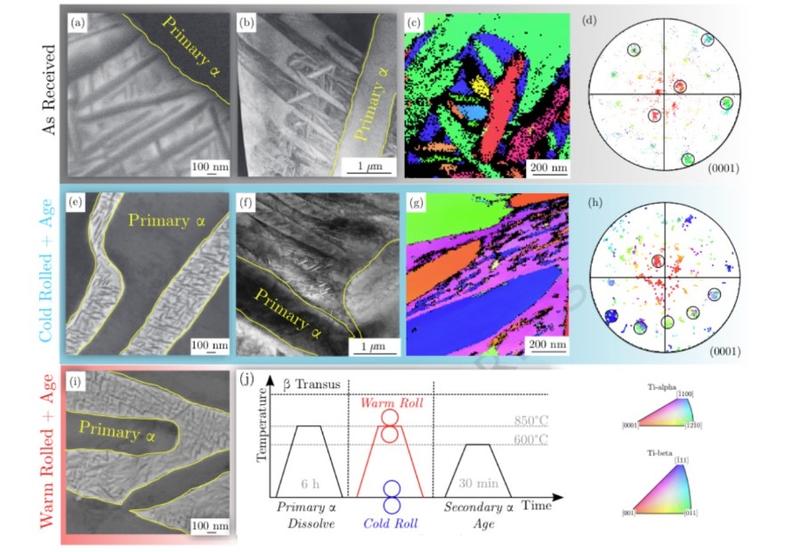
Researchers from Imperial College London, Lawrence Berkeley National Laboratory, Stanford University, ePSIC and Oxford University demonstrate in this paper* that the smallest secondary alpha every made in titanium, using in-situ heated TEM, 4D-STEM, TKD, thermomechanical processing and a range of mechanical testing techniques.
Significant improvement was in strength and fatigue benefit with no texture change, and it was noted that secondary alpha can be encouraged to nucleate and grow from dislocations within a beta matrix. The result is an improvement in the high cycle fatigue strength of the material by 95 MPa, to around 920 MPa in un-notched high cycle fatigue at 10^6 cycles, or 200 MJ/kg, which is among the highest of all structural materials.
*'Defect-assisted refinement of nanoscale alpha in titanium alloys', published in Communications Materials

