


Using APT to reveal the complex chemistry of grain boundaries
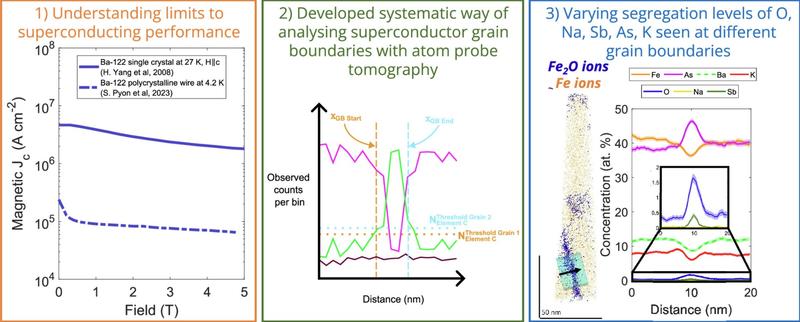
Led by this department, a collaborative team from Oxford and Florida State University looked at how iron-based superconductors have attractive properties for high-field applications, but also at how there is a lack of understanding of the effect of grain boundary chemistry on the in-field performance.
The near atomic-scale resolution, ppm sensitivity and 3D analysis offered by atom probe tomography makes it a powerful tool to investigate the nanoscale structure and chemistry of these defects in fine-grained K-doped BaFe2As2 samples. A computational method to systematically extract and compare the Gibbsian interfacial excess of chemical species across grain boundaries is also explored in this paper*. The robustness of the method was tested by evaluating the effects of selected variables on simulated APT datasets. The accuracy and precision of the calculated Gibbsian interfacial excess were found to be stable over a range of analysis conditions: varying grain boundary widths and detection efficiencies, spatial precisions below 1.5 nm, and bin widths between 1.2 and 1.6 nm. For the K-doped BaFe2As2 samples studied, segregation of As, Ba, K and impurities of O. Na and Sb were found at grain boundaries.
The Gibbsian excess values were found to vary widely between different boundaries, showing the complexity of the grain boundary chemistry in this materials. Possible links between the observed critical current density (Jc) of these samples and their nano- and micro- structure are also investigated and discussed.
* 'Revealing the complex chemistry of grain boundaries in K-doped BaFe2As2 with atom probe tomography'. published in Journal of Materials Science & Technology.

