


EL002 - Deep Learning for AI-driven battery degradation and safety studies
X-ray tomography and radiography have become indispensable tools for understanding battery state of health (SoH) and state of safety (SoS). In situ and operando imaging platforms now enable a range of environments to be replicated during accelerated stress tests (ASTs), while multi-modal approaches provide an unparalleled combination of structural, thermal, chemical, and mechanical information that cannot be obtained through ex situ methods. However, the rapid growth in experimental capability has created a significant data bottleneck. Time-resolved X-ray imaging experiments routinely generate tens of terabytes of high-quality data, even for relatively simple studies. Conventional reconstruction, segmentation, and quantitative analysis workflows can require months or even years to complete, meaning that large volumes of potentially transformative data remain underutilised. As a result, the extraction of robust, transferable insights has not kept pace with advances in imaging technology.
This project will address this challenge by transforming the “data problem” into a research opportunity. The central aim is to develop and train advanced deep learning models capable of rapidly and reliably extracting predefined quantitative metrics from large, multi-modal existing datasets. While automated image analysis tools are well established in fields such as medical imaging, machine learning approaches tailored to complex physical science data remain underdeveloped and are not yet suitable for high-throughput operando battery experiments. By integrating AI-driven analysis directly into the experimental workflow, this project will significantly enhance research efficiency, reproducibility, and experimental agility.
Within the research group, we have developed instrumentation that embeds AI directly into detectors and experimental hardware (AIXISuMM). A particularly innovative aspect of this platform is the integration of machine learning models within the data acquisition system itself, enabling automated data collection, real-time experimental control, and on-the-fly analysis. The project will build upon this capability by interfacing battery test cells used for ASTs with multiple characterisation modalities, including X-ray imaging, thermal analysis, videography, and acoustic sensing. Lightweight, high-speed AI models will be designed to interpret and fuse these multi-modal data streams, delivering live quantification of predefined figures of merit during experiments. By coupling advanced imaging with embedded AI, the project aims to establish a new paradigm for intelligent, adaptive battery diagnostics, accelerating both fundamental understanding of degradation mechanisms and the development of safer, longer-lasting energy storage technologies.
This project is fully funded by EPSRC and Fortescue Zero through a 3.5-year studentship. This studentship will cover course fees at Home rate and offer a stipend of at least £21,805 per year (pro-rata for the final six-months). The starting date for the studentship and project is 5th October 2026.
Eligibility is restricted to applicants with Home fee status due to funding restrictions. Information on fee status can be found at http://www.ox.ac.uk/admissions/graduate/fees-and-funding/fees-and-other-... .
Reference
[1] Fransson, Matilda, Ludovic Broche, Jonas Pfaff, et al. ‘4D Insights into Lithium-Ion Battery Sidewall Rupture during Thermal Runaway’. Cell Reports Physical Science 7, no. 2 (2026). https://doi.org/10.1016/j.xcrp.2026.103095.
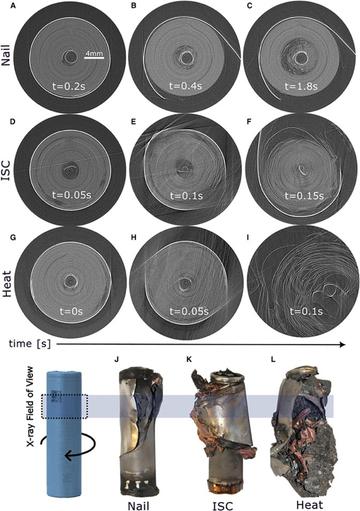
Internal cell structure evolution during failure [1]

