


Evolution of electrospun polycaprolactone microfibers for biomedial applications
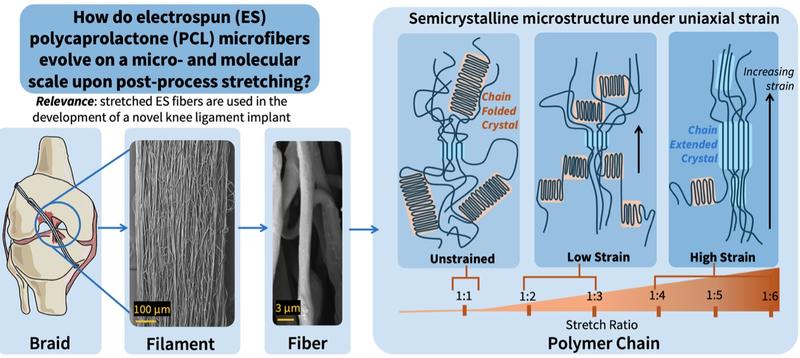
The performance and degradation of polymeric medical yarns are strongly dependent on their microstructure, which can evolve significantly during fabrication. In 'Stretch-induced microstructural evolution of electrospun polycaprolactone microfibers for biomedical applications', published in ACS Applied Polymer Materials, the authors investigate and model how the microstructure of microfibrous electrospun filaments change during the critical processing step of uniaxial stretching.
The filaments designed for use in a knee ligament regeneration implant were specifically studied. This material was made from biodegradable, semicrystalline polycaprolactone, where structural changes were characterised at both the fibre and the molecular scales. Stretching led to fibre alignment, thinning and coalescence, as revealed by microcomputed tomography and scanning electron microscopy. At the molecular scale, the crystalline microarchitecture transformed profoundly, as shown by differential scanning calorimetry, one-dimensional and two-dimensional X-ray diffraction, and by dynamic mechanical thermal analysis.
Based on these findings, the authors propose a conceptual model for stretch-induced microstructural evolution: at lower strains, chain-folded crystals fragment while amorphous chains extend; at higher strains, CFCs unfold and recrystallise with extended chains into more thermodynamically stable chain-extended crystals aligned with the stretch axis. This mechanism clarifies how uniaxial strain reorganises semicrystalline domains in PLC, with important implications for thermochemical and degradative properties relevant to implant performance. Understanding how microstructure responds to stretching enables the future development of more accurate simulations of complex fibrous materials under physiological conditions and informs the optimisation of fabrication and design parameters for next-generation medical yarns.

