


Performance comparison of transition metal fluoride conversion cathodes in thin-film solid-state batteries
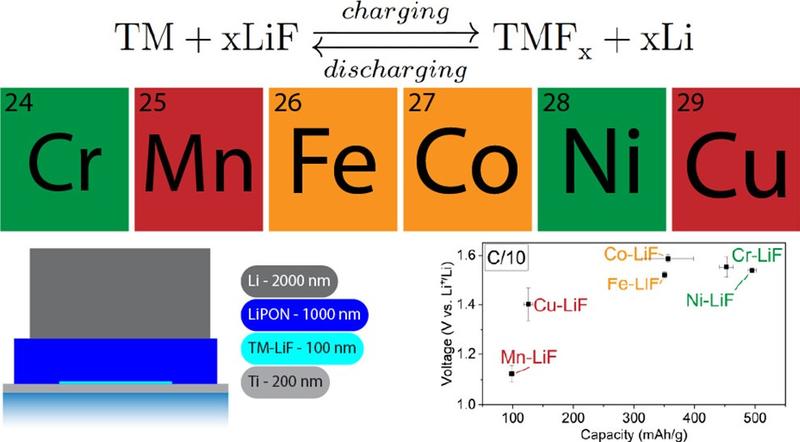
Transition metal fluorides (TMDs) are promising alternatives for Li battery cathode active materials as they can show specific capacities up to 619 mAh/g for CrF3, compared to 272 mAh/g for LiNi0.8Mn0.1O2, a commonly used intercalation cathode. TMFs are intrinsically difficult to study due to their incompatibility with typical liquid electrolytes and the need for conductive additives to ensure sufficient utilisation.
In the paper 'Performance comparison of transition metal (Cr, Mn, Co, Ni, Cu)-fluoride conversion cathodes in thin-film solid-state batteries', published in ACS Applied Energy Materials, thin-film solid-state devices are used to compare six transition metals mixed with LiF in a 1.1:2 TM/LiF ratio (where TM=Cr, Mn, Fe, Co Ni, or Cu) without the influence of additive and electrolyte interactions. C/10 delithiated capacities of 540, 113, 402, 407, 566 and 143 mAh/g are shown for (Cr, Mn, Fe, Co, Ni, Cu)-LiF cathodes, respectively. Chromium fluoride consistently outperforms the other cathodes up to 8C (190/219 mAh/g, lithiated/delithiated).
Differences between the behaviour of the TM-LiF cathodes are explored using electrochemical characterisation and atomistic simulations. The choice of TM has a significant impact on cathode performance, which is likely to be connected to their distinct chemical natures, changing the thermodynamics and pathway of the conversion reaction.

