


Agryrodite solid electrolytes and the role of phosphorus
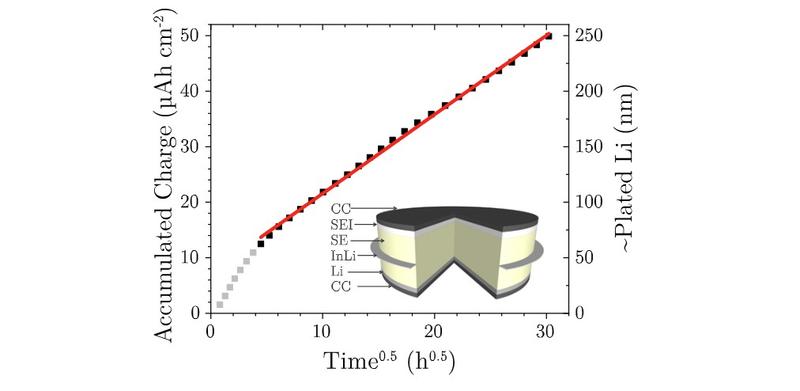
The solid electrolyte interphase that forms on Li6PS5Cl argyrodite solid electrolytes has been reported to continually grow through a diffusion-controlled process, yet this process is not fully understood.
In the paper 'The role of phosphorus in the solid electrolyte interphase or argyrodite solid electrolytes', published in Nature Communications, the authors use a combination of electrochemical and X-ray photoelectron spectroscopy techniques to elucidate the role of phosphorus in this growth mechanism. They uncover how Li6PS5Cl can decompose at potentials well above the full reduction to Li3P, forming partially lithiated phosphorus species, LixP.
The authors also provide evidence of a gradient of LixP species throughout the solid electrolyte interphase and propose a growth mechanism in which the rate-determining step is the diffusion of lithium through LixP. It is predicted that that solid electrolyte interphase growth will be continuous providing metallic lithium is present and a LixP percolation pathway exists. This highlights the importance of understanding and engineering solid electrolyte interphase composition and nanostructure in solid-state batteries.
The authors conclude that this growth mechanism would apply to any solid electrolyte interphase that can contain partially lithiated phosphorous, or potentially any lithium alloy.

