


Transparent conducting electrodes and solar cell efficiency
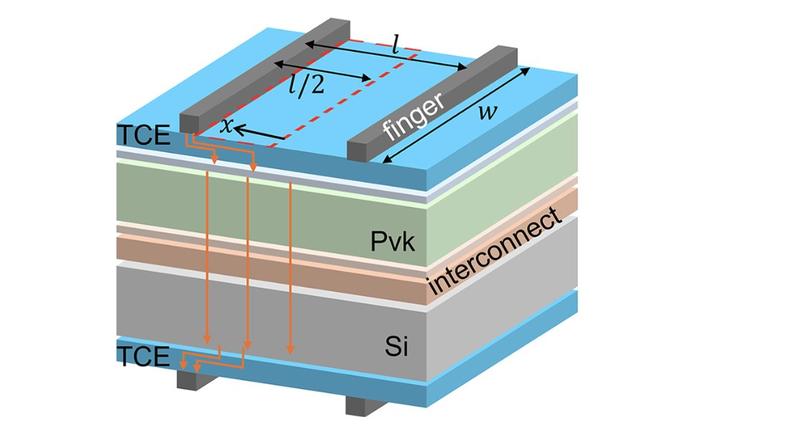
In 'The impact of transparent conducting electrodes on tandem solar cell efficiency' published in Joule, Professor Ruy Sebastian Bonilla explains how monolithic two-terminal perovskite-silicon (Pvk-Si) tandem solar cells have proved themselves to be the highest performing choice for industry. It is therefore critical to model the practical efficiency limits of Pvk-Si tandems by incorporating sub-cell level recombination, absorption and optical coupling mechanisms, and he advises not overlooking the critical loss mechanism inherent to all monolithic tandem architectures: the optical and resistive losses induced by transparent conductive electrodes (TCEs).
While optical modelling typically accounts for parasitic absorption and interference from multilayer stacks, the lateral resistance of TCEs - especially in bifacial or front-illuminated configurations - remains unquantified in most system-level models. Moreover, the geometric interdependence between TCE sheet resistance, finger spacing and metal shading introduces trade-offs that fundamentally constrain the power output but are rarely captured in practical efficiency limit calculations.
In this commentary, Professor Bonilla presents a unified optical-electrical modelling approach to quantify the efficiency penalties introduced by realistic TCEs in two-tier tandem solar cells made up by any two absorbers. He derives closed-formed expressions for lateral resistive losses from sheet resistance and geometry and integrate them into a multi-diode equivalent circuit model solved using the PySpice simulation framework. Optical transmission losses are evaluated via the transfer matrix method for various TCE stacks, including the impact of antireflection coatings and sputter buffer layers. By coupling these effects with a geometry-aware generation model, Professor Bonilla identifies the optimal finger spacing for a range of TCE conductivities and transparencies, and evaluates the practical efficiency ceiling as a function of TCE parameters. Professor Bonilla used the widely reported properties for Pvk-Si tandems as a benchmark, but the algorithm remains valid for a variety of technologies. The resulting model elucidates the underexplored (but significant) role of TCEs in limited tandem performance, and provides practical guidelines for TCE optimisation in future device architectures.

