


Detection and Prediction of Moisture Flow through Intergranular Networks
Understanding transport through three-dimensional networks in microstructures is an important challenge in materials science. This project is concerned with the problem of moisture flow rates through intergranular pathways in a metal alloy.
The safe, secure storage of fuel used in the UK fleet of advanced gas-cooled nuclear reactors (AGR) must be assured until geological disposal. After removal from the reactor, the 'spent' fuel is stored in water while cooling from the heat it generates by radioactive decay. The corrosion resistance of certain grain boundaries in the microstructure of the stainless steel cladding, which contains the fuel, may be reduced after its time in the reactor (https://doi.org/10.1016/j.corsci.2014.04.050, https://doi.org/10.1016/j.matdes.2019.108368). Intergranular corrosion damage can create pathways for water to percolate through the cladding. This could affect the subsequent drying of the fuel, which must be done before disposal, and it is important to be able to predict moisture transport through the cladding. However, the tendency for intergranular corrosion depends on the steel chemistry, its thermomechanical processing and the history of the reactor operation. This would affect the damage network and the flow through it, and a new approach is needed to address this complex problem.
This project aims to develop an experimental method to image, map and quantify how moisture penetrates intergranular corrosion networks. The first objective is to investigate local moisture permeation through a model material (thermally sensitised stainless steel) by using a novel modification of the “Ca-test” to detect the transparency change of a hydrating calcium coating. The three-dimensional structure of the intergranular corrosion damage to these permeation sites will then be examined by correlative X-ray computed tomography and electron microscopy. The data will support the application of transport models through connected networks (e.g. https://doi.org/10.1180/minmag.2012.076.8.12, https://doi.org/10.1016/j.tafmec.2007.08.007) aiming for large scale simulations of moisture flow through corrosion-damaged fuel clad.
The project is suitable for graduates with an engineering, mathematical or physical sciences background.
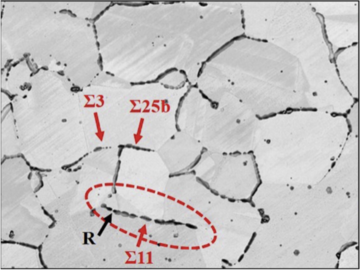
The different corrosion susceptibility of grain boundaries in stainless steel (https://doi.org/10.1016/j.matdes.2019.108368)

