


Thermomigration of Hydrogen in Reactor Fuel Cladding Materials
This project will investigate how temperature gradients drive hydrogen diffusion. This little-studied effect, called thermomigration, can strongly impact hydrogen embrittlement. It is especially important in systems with steep thermal gradients, such as heat-exchangers in hydrogen fuel systems, nuclear fuel cladding and fusion reactor armour. This project will develop a new experimental rig to measure thermomigration and use this to construct a machine-learning-enhanced digital material twin to correctly capture the effect.
Hydrogen thermomigration is important for structural metals exposed to hydrogen (H), as H embrittlement and hydride precipitation are sensitive to local concentration. In fission reactor fuel cladding, steep temperature gradients arise radially from internal heating and water-side cooling. Thermomigration is likely to dominate the H concentration profile and must be properly understood for high fidelity modelling of H and hydride embrittlement in cladding materials. Unfortunately, there is a lack of physical clarity regarding of the driving force(s) for thermomigration, including the complex associated electronic effects. The development of new modelling capabilities, underpinned by reliable experimental data across broad temperature and temperature gradient ranges, is urgently needed.
The heat of transport, 𝑄∗, is used to quantify the direction and magnitude of thermomigration. Surprisingly, there is little experimental 𝑄∗data, with the most prominent examples found in Zr cladding alloy [1-3]. However, this data was attained post hoc by measuring H content at ambient temperature [4], introducing considerable uncertainties. The most robust heat of transport measurements were reported by Gonzalez and Oriani in the 1960’s for pure Fe and pure Ni, using a thermo-osmosis technique to measure 𝑄∗ in the 400 − 600 °C range [5].
In this project, a new rig will be constructed to allow robust 𝑄∗ measurements across broad temperature ranges. It will consist of a permeation cell with precise temperature gradient control across thin membrane samples, coupled with a mass spectrometer for highly sensitive H flux measurements. A detailed digital twin of the experiment will be constructed to allow rapid inversion of experimental measurements into Q* data.
The new heat-of-transport data will allow the student to test a physically-based model we recently proposed to capture the temperature dependence of heat-of-transport [6], and to calibrate this model for Zr. To maximise impact, the new “thermomigration” digital material twin will be integrated into the comprehensive material model being continuously developed by Rolls- Royce for fuel cladding design and optimisation.
This studentship is jointly funded by Rolls-Royce and the Materials 4.0 CDT. It is open to both Home and Overseas students.
Course fees are covered at the level set for UK students (at least £10,940 p.a.). Overseas students are responsible for paying the difference in Home fees and Overseas fees. For the first year this difference is expected to be £25,320 and is likely to be at least this amount for a further three years. The stipend (tax-free maintenance grant) is at least £21,805 p.a. for the first year, and at least this amount for a further three years.
The ideal candidate will have a strong background in Physics, Material Science, Engineering or a closely related discipline. Excellent analytical skills, enthusiasm for experimental work, outstanding written and verbal communication skills and a strong teamwork ethic are all essential.
For more information, please contact the lead supervisor Prof. Felix Hofmann (felix.hofmann@eng.ox.ac.uk).
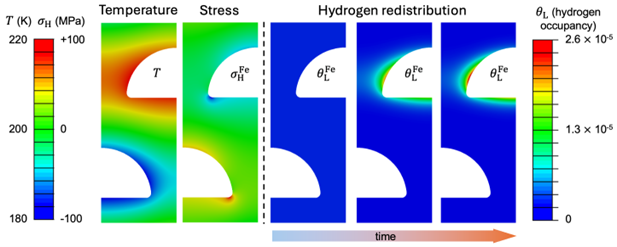
Temperature- and stress-driven hydrogen redistribution in a prototypical heat-exchange “unit cell” using our newly developed thermomigration framework
References:
[1] M. Veshchunov, V. Shestak, and V. Ozrin, Journal of Nuclear Materials 472, 65 (2016).
[2] M. Sugisaki, H. Furuya, H. Sekiya, and K. Hashizume, Fusion Technology 14, 723 (1988).
[3] H. Maki and M. Sato, Journal of Nuclear Science and Technology 12, 637 (1975).
[4] S. Kang, P. Huang, V. Petrov, A. Manera, T. Ahn, B. Kammenzind, A.T. Motta, Journal of Nuclear Materials, 573, (2023).
[5] O.D. Gonzalez and R.A. Oriani, Thermal diffusion of dissolved hydrogen isotopes in iron and nickel, Trans. Met. Soc. AIME Vol: 233 (1965).
[6] D.J. Long, E. Tarleton, A.C.F. Cocks, F. Hofmann, https://arxiv.org/abs/2508.05327, (2025)

