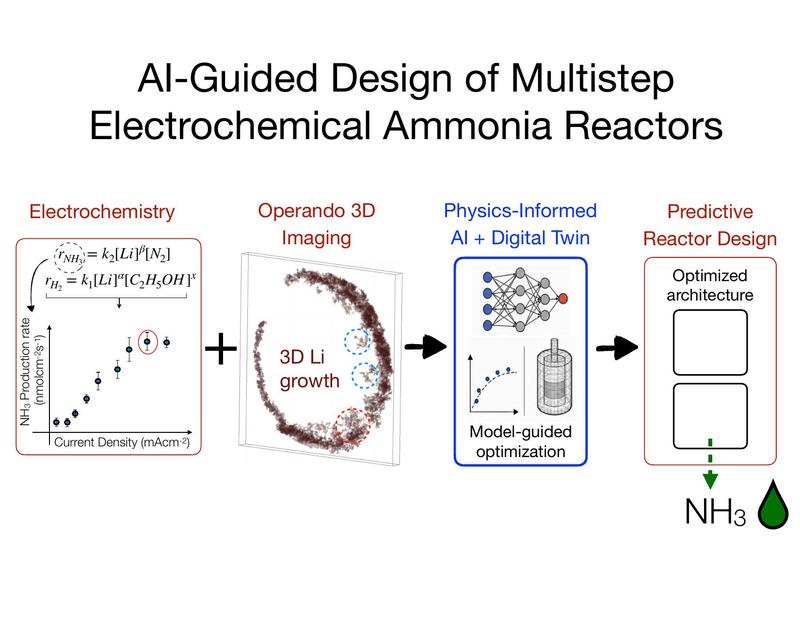


MY003 - Theory- and AI-Guided Design of Multistep Electrochemical Reactors for Next-Generation Ammonia Synthesis
Electrochemical ammonia synthesis offers a potential route to producing NH₃ under
milder and more distributed conditions than conventional thermochemical processes.
However, emerging systems such as Li-mediated nitrogen reduction involve coupled
electrochemical and chemical steps, with performance strongly influenced by reaction
kinetics, mass transport, and operating conditions.[1] More broadly, spatially
heterogeneous electrochemical processes can evolve in three dimensions and require
experiments capable of resolving local behavior rather than relying solely on cellaveraged measurements.[2]
This DPhil will develop a theory- and AI-guided framework for the predictive
design of multistep electrochemical ammonia reactors. The central objective is to
move beyond empirical reactor optimization by developing physics-informed models
that describe how mass transport, current distribution, electrochemical operating
conditions, evolving interfacial states, and reactor architecture collectively determine
ammonia productivity, selectivity, and energy efficiency. Physics-informed machine
learning provides a powerful framework for integrating physical governing principles with
data-driven models, particularly where experimental datasets are sparse or expensive
to generate.[3] At the materials scale, recent work combining ab initio calculations with
molecular dynamics and machine-learning interatomic potentials demonstrates how
physics-based simulation and machine learning can resolve mechanistic behavior in
complex electrochemical energy materials.[4]
These models will be combined with machine-learning approaches to create a digital
twin of the multistep reactor for next-generation ammonia synthesis. AI will be used to
identify complex relationships between reactor design, operating conditions, and
performance; construct reduced-order models from simulation and experimental data;
and efficiently explore multidimensional design spaces. Quantifying predictive
uncertainty will be an important component of model-guided experimentation and
autonomous decision-making.[5]
Dr Maha Yusuf brings expertise in electrochemistry, reactor design, and operando 3D
characterization; Prof Philip Torr brings expertise in AI and machine learning; and Prof
M. Saiful Islam brings expertise in atomistic modeling, computational materials
chemistry, and machine-learning-enabled simulation of energy materials.
Together, their complementary expertise positions the project at the intersection of
electrochemistry, transport theory, computational materials science, reactor
engineering, machine learning, and digital-twin development, ultimately enabling the
predictive design of next-generation electrochemical ammonia reactors.
References
1. Lazouski, N.; Schiffer, Z. J.; Williams, K.; Manthiram, K. “Understanding
Continuous Lithium-Mediated Electrochemical Nitrogen Reduction.” Joule 2019,
3, 1127–1139.
2. Yusuf, M. et al. “Neutron-Friendly Li-Ion Battery Coin Cell for In Situ 3D
Visualization of Li Plating.” Journal of The Electrochemical Society 2025, 172,
090531.
3. Karniadakis, G. E. et al. “Physics-Informed Machine Learning.” Nature Reviews
Physics 2021, 3, 422–440.
4. Both, S.; Poletayev, A. D.; Danner, T.; Latz, A.; Islam, M. S. “Probing Surface
Degradation Pathways of Charged Nickel-Oxide Cathode Materials Using
Machine-Learning Interatomic Potentials.” ACS Applied Materials & Interfaces
2025, 17, 56612–56620.
5. Mukhoti, J.; Kirsch, A.; van Amersfoort, J.; Torr, P. H. S.; Gal, Y. “Deep
Deterministic Uncertainty: A New Simple Baseline.” CVPR 2023.