


Temperature-dependent dynamic disproportionation in LiNiO2
Nickelate materials offer diverse functionalities for energy and computing applications. Lithium nickel oxide (LiNiO2) is an archetypal layered nickelate, but the electronic structure of this correlated material is not yet fully understood.
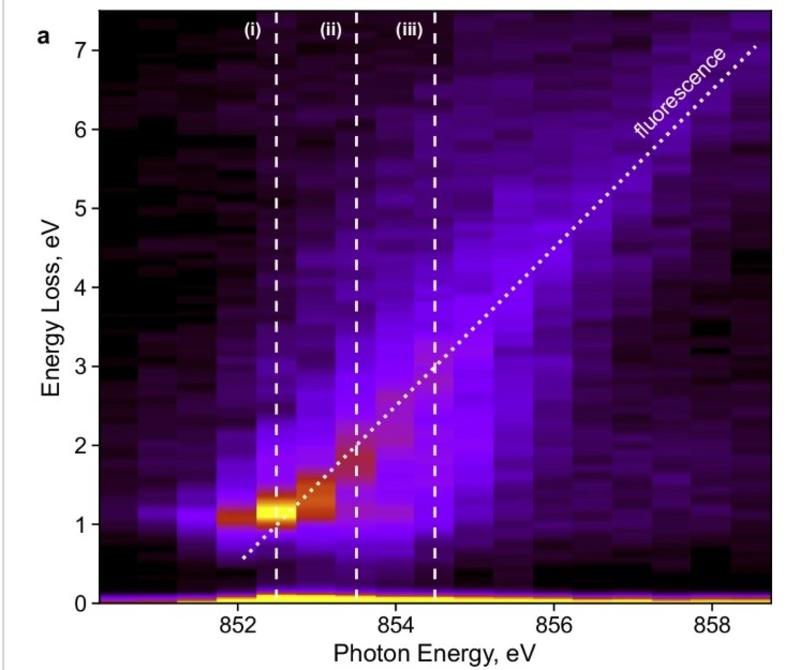
In the paper 'Temperature-dependent dynamic disproportionation in LiNiO2', published in Nature Communications, the authors investigate the temperature-dependent speciation and spin dynamics of Ni ions in LiNiO2. Ab initio simulations predict that Ni ions disproportionate into three states, which dynamically interconvert and whose populations vary with temperature. These predictions are verified using x-ray absorption spectroscopy, x-ray magnetic circular dichroism, and resonant inelastic x-ray scattering at the NiL3,2-edge. Charge-transfer multiplet calculations consistent with disproportionation reproduce all experimental features.
The results support a model of dynamic disproportionation that explains diverse physical observations of LiNiO2, including magnetometry, thermally activated electronic conduction, diffractometry, core-level spectroscopies, and the stability of ubiquitous antisite defects. This unified understanding of the material properties of LiNiO2 is important for applications of nickelate materials as battery cathodes, catalysts and superconductors.

