


Solid-state battery performance: bromine-rich argyrodites compositions
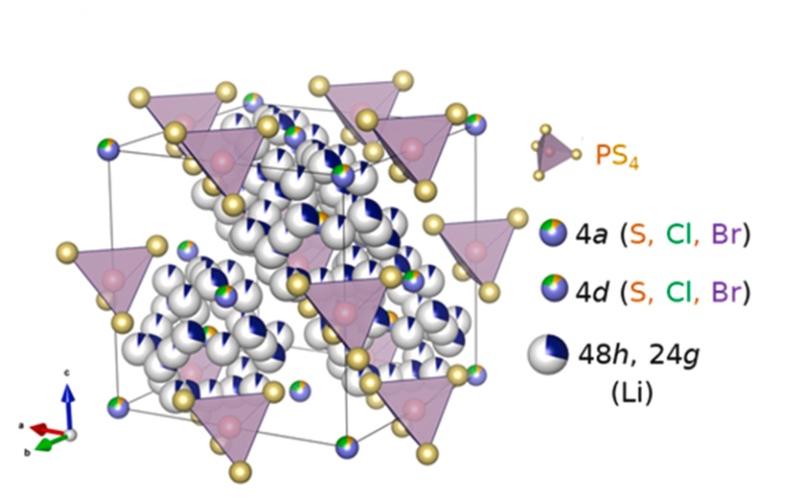
Halide-enriched lithium argyrodite superionic conductors are considered as promising candidates for all-solid-state batteries due to their soft structure and high ionic conductivity. Challenges remain, including chemical instability and incompatibility with anode materials. Additionally, a deeper understanding of the fundamental aspects of ionic transport and performance is needed.
In the paper 'Bromine-rich argyrodites compositions: enhancing lithium-ion conductivity for improved solid-state battery performance', published in Journal of Power Sources. the authors investigate two argyrodite mixed-halide series of compositions (Li6-x-PS5-xBrClx and Li5.5PS4.5Br1.5-x-Clx). By employing a range of techniques including X-ray diffraction (XRD), neutron diffraction, nuclear magnetic resonance (NMR) spectroscopy, electrochemical impedance spectroscopy and machine learning based molecular dynamics, they find that increasing the halide substitution enhances ionic conductivity. Notably, the Li5.4PS4.4BrCl0.6 composition achieves an ionic conductivity of 10mS/cm, and demonstrates superior air stability compared to conventional lithium argyrodites. This also allows for the fabrication of well-performing all solid-state-batteries.
The results reveal that in lithium-poor compositions the lithium environments in the 4a and 4d cages become more alike, facilitating fast long-range lithium-ion transport. This work paves the way for development of air-stable, high-conductivity sulfide electrolytes, advancing the practical implementation of solid-state batteries.

