


Metallic interlayers at the Solid State Battery interface
Solid State Batteries (SSBs) offer step-change improvements over conventional lithium-ion cells in terms of energy density, safety and fast-charging capability. These advantages could be the answer for electrifying transportation, include aviation. Achieving this prospect, however, requires addressing fundamental limitations at the lithium-solid electrolyte interface (most notably, interfacial challenges created by plating the first cycle to adopt an 'anode-less' configuration, which leads to non-uniform deposition, void formation, and unstable interphase, which accelerate capacity fade and raise critical concerns for long-term durability and safety).
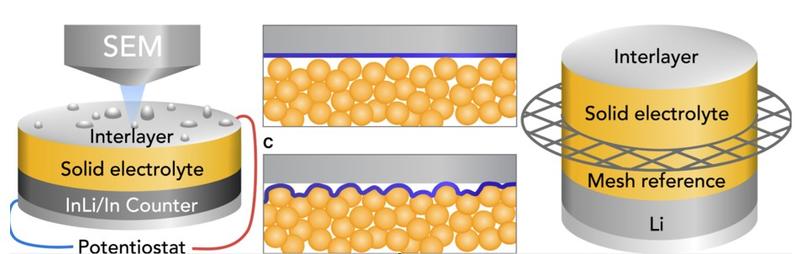
In the paper 'Impact of metallic interlayers at the lithium-Li6PC5Cl solid electrolyte interface', published in Joule, the authors explain how alloy interlayers have emerged as a promising solution to the issue; by reversibly lithiating prior to lithium deposition, the alloy interlayers can buffer mechanical contact, regulate ion transport, and influence the morphology of plated lithium.
The authors employed operando scanning electron microscopy (SEM) to directly visualise lithiation dynamics within alloy interlayers, and the subsequent evolution of lithium plating at the solid-electrolyte interface. These observations reveal how alloy composition and interfacial chemistry govern lithium morphology and SEI development. The results establish design principles for controlled plating and interfacial stabilisation, providing new pathways to improve the performance, lifetime and commercial viability of anode-less SSBs.

