


Rotational stocking faults in the ionic conductor Li3ScCi6
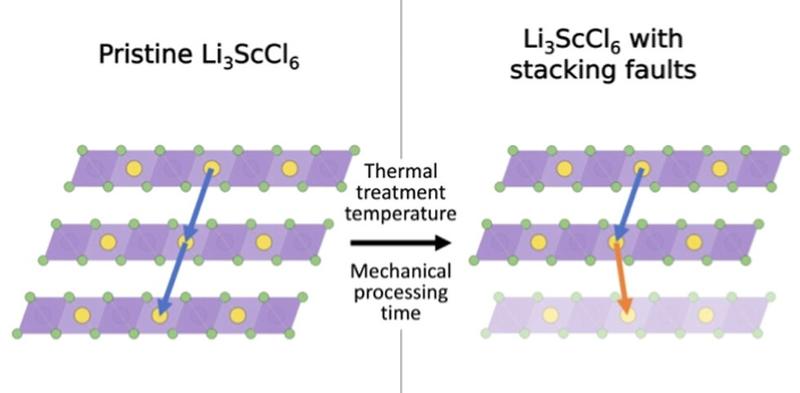
Professor Saiful Islam and collaborators explain in this paper, published in Chemistry of Materials, that halide-based solid electrolytes have gained recent interest due to their promising iconic conductivity and wide electrochemical stability window, but that the influence of synthesis conditions on structure is not fully characterised.
In 'Rotational stacking faults in the ionic conductor Li3ScCI6', Professor Islam and his fellow authors report a combined experimental and computational study of the effect of thermal treatment temperature on the structure and Li+ conduction dynamic of the superionic halide Li3ScCI6. Synchrotron diffraction analysis shows that samples treated between 450oc and 750oC form the monoclinic Li3ScCI6 structure and contain rotational stacking faults, whose density increases with thermal treatment temperature and mechanical processing time.
Impedance spectroscopy, nuclear magnetic resonance spectroscopy, and molecular dynamics simulations using machine-learned interatomic potentials, however, indicate that these faults have a negligible effect on long-range Li+ conductivity, though local Li+ dynamics are modified. This work demonstrates that Li3ScCI6 maintains robust transport properties despite rotational stacking faults, and highlights the importance of in-depth structural analyses for understanding the relationships between synthesis protocols, structure, and ionic transport in halide solid electronics.

