
GDM002 - Plasmonic Oxide Materials for All-Optical Memory and Neuromorphic Computing
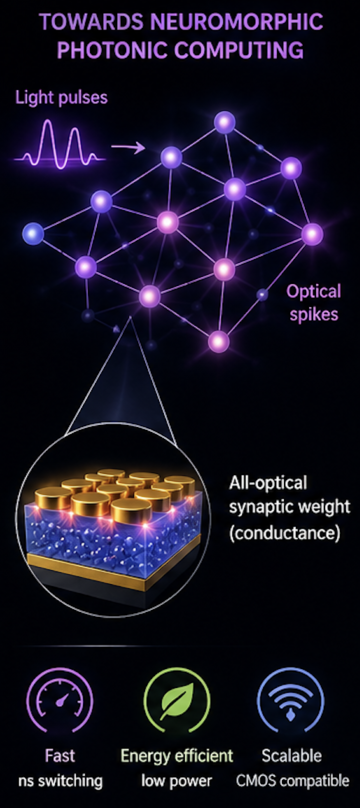
Can light be used to write, erase and control electronic memory without electrical contacts? This project will develop a new approach to all-optical memory using photoactive oxide thin films and plasmonic nanostructures.
Tungsten oxide (WO₃) is an intriguing functional material whose electrical conductivity can be reversibly changed by light. This makes it a promising platform for fast, low-power optical memory and neuromorphic computing. However, current devices suffer from weak photoresponses, instability and limited reproducibility. This project will explore how nanoscale control of light can overcome these limitations.
You’ll combine functional oxide thin-film fabrication with plasmonic nanostructuring, creating structures that concentrate light into nanoscale regions and enhance light–matter interactions. You will investigate how optical excitation influences defects and charge transport in WO₃, and how these processes can be controlled to achieve reliable switching between different memory states.
The project sits at the intersection of nanophotonics, functional materials, optoelectronics and neuromorphic device physics, with potential applications in photonic computing, low-power information processing and next-generation memory technologies.
You’ll gain hands-on training in:
-Thin-film deposition and nanofabrication
-Optical and electrical device characterisation
-Plasmonics and nanoscale light–matter interactions
-Time-resolved measurements and data analysis
We welcome applicants from physics, materials science, chemistry, electrical engineering, photonics or related disciplines. You don’t need to be an expert in all these areas — full training will be provided, and curiosity and enthusiasm for interdisciplinary research are most important.