


Next generation solar panels
Progressing towards cheaper electricity and more efficient solar panels
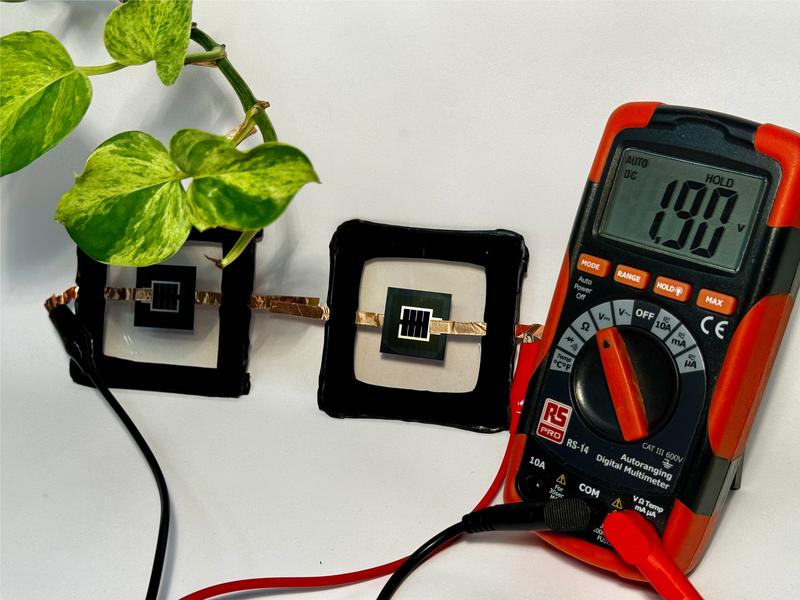
Image by RS Bonilla/JC Gutierrez
A solution to environmental factors affecting efficiencies
An international team of researchers, which included Professor Sebastian Bonilla of this department, have been working on the issue of inefficiencies in solar panels when they are installed in areas subjected to such challenges as partial shade, dust, leaves and other natural litter. Currently, such environmental factors can force the shaded cells within the panels into 'reverse bias', which can cause dangerous hotspots, irreversible degradation, and even modular failure because the electric field jumps at the interface between the perovskite layer and the neighbouring C60 layer, because of a mismatch in their dielectric constants. This sharp discontinuity pulls ions towards the interface, abnormally bends the energy bands, and opens a pathway for a destructive leakage current to flow.
Tackling this problem, the researchers found that by inserting graded dielectric layers (GDL) the field was smoothed, and these degradation mechanisms were suppressed, GDLs are ultra-thin, two-step buffers that gently smooth out the electrical transition - almost like grading a steep cliff into a gentle slope. By doing so, it suppresses ion pile-up at the interface, removes the abnormal band bending, and shuts off the harmful tunnelling current. As a result, the tandem cell can survive hundreds of hours under reverse-bias stress without significant performance loss.
This interface-engineering concept goes beyond solar cells: it could be used in any multilayer electronic or energy device where a similar dielectric mismatch threatens long-term reliability.
This is good news for the commercial production of the panels, as the GDLs prevent degradation and therefore improve efficiencies and duration of the panels. If these tandem panels become as robust as the mainstream silicon panels used today, they will produce far more electricity from the same roof space, which could result in the cost of each kilowatt-hour of solar electricity being dropped substantially in the future.
A roof of such long-lived, high yield panels will generate enough affordable electricity to run a heat pump or electric radiators through the winter, making the running cost of electric home heating progressively cheaper than burning fossil fuels. In a decade's time, this advance could help make 'solar-powered heating' the default, cheaper option for millions of households, while also cutting carbon emissions.
"This work improves perovskite/silicon tandem solar cells by making them much more stable under reverse-bias stress caused by partial shading, which is essential for safe, reliable, and lower-cost solar electricity in everyday life.
We made advanced solar cells last longer and keep working better when part of a panel is shaded.
This research brings highly efficient, durable tandem solar panels close to real-world commercialisation".
Professor Zonglong Zhu (City University of Hong Kong)
In more technical terms, the large dielectric constant (εr) mismatch between the perovskite absorber and the C60 electron transport layer causes a severe electric field discontinuity at that interface. Under the reverse bias, this discontinuity triggers abnormal band bending and greatly enhances hole tunnelling current, which in turn oxidises halide ions and drives irreversible degradation.
To eliminate the discontinuity, a graded dielectric layer (GDL) strategy consisting of two ultra-thin interlayers is introduced between perovskite and C60: GDLL1 with a medium εr, GDLL2 with a low εr. A metric termed the Dielectric Factor (DF) is defined; a DF close to 1 corresponds to a nearly continuous electric field profile.
By smoothing the electric field discontinuity, the GDL suppresses ion accumulation at the perovskite/C60 interface, alleviates the abnormal band bending, and thereby greatly reduces the reverse-bias tunnelling current.
Tandem cells incorporating GDL achieve power conversion efficiencies of 34.18% on HJT silicon bottom cells (certified 33.76%) and 34.03% on TOPCon silicon bottom cells. After 1,000 hours of -15 V reverse-bias stress, the GDL-based tandems retain >92% of their initial efficiency. As Professor Bonilla, who collaborated with the CUHK team says:
This work demonstrates a key innovation in the area of solar energy reliability. An often-ignored issue with solar modules is what happens when part of the sunlight is shaded by trees and obstacles. This leads to harmful electrical conditions inside which have so far led to unwanted degradation of the devices inside of solar panels.
In this work, not only do we demonstrate tandem efficiencies over 32% at the leading edge of the technology, but we also enable retention of such high efficiencies under some of the harshest partial shading conditions.
It's an outstanding step forward in tandem photovoltaics".
This study identifies electric field discontinuity from dielectric mismatch as a key reverse-bias failure mechanism in perovskite/silicon tandems, and provides a scalable interface-engineering solution (GDL) that simultaneously boosts efficiency beyond 34% and dramatically improves reverse-bias resilience.
By demonstrating robustness in both HJT silicon- and TOPCOn silicon-based devices under realistic shading conditions, the work removes a major hurdle for commercialising high-efficiency tandem photovoltaics.
Read the paper on this ground-breaking research, as published in Nature Energy, by clicking on the title below:

