


Na-rich and Li-rich disordered rocksalt batteries: significance of ion size
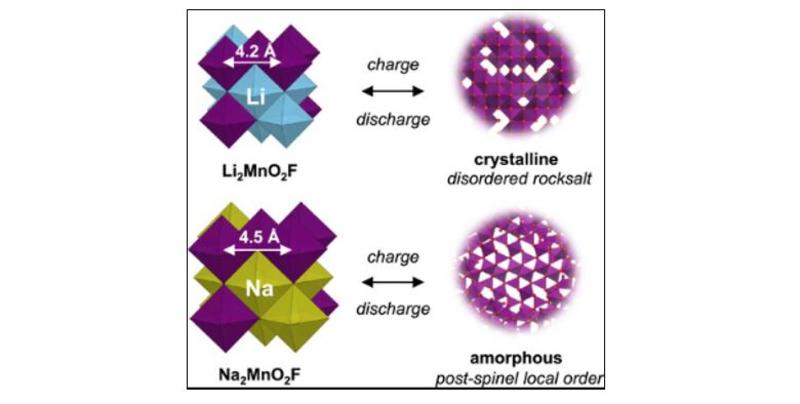
Understanding the influence of alkali ion size on the structural evolution and redox chemistry of disordered rocksalt (DRS) cathodes is essential for the design of high-capacity materials.
While Li-based DRS compounds such as Li2MnO2F retain their structure upon delithiation, it is poorly understood how the knowledge of the structural and redox chemistry translates from the Li-rich to the Na-rich analogues.
In this paper*, published in a Rising Stars edition of Advanced Materials, the authors investigate the contrasting intercalation mechanisms in isostructural LiMnO2F and Na2MnO2F. They show that while Li2MnO2F undergoes a solid solution reaction with the disordered rocksalt framework largely preserved, NaMnO2F experiences extensive amorphisation and lattice collapse during desolidation. This is attributed to the larger ionic radius of Na+ which destabilises the host structure and alters the redox dynamics.
Despite this structural degradation, more Na+ can be extracted from Na2MnO2F than Li+ from Li2MnO2Fm resulting in significantly higher capacities within equivalent voltage windows. The larger Na+ ion also lowers the average voltage, further enhancing the accessible capacity. Remarkably, Na2MnO2F still delivers one of the highest energy densities reported for Na-ion cathodes.

