


Mn-rich electrodes: investigating asymmetric electrochemical, structural & electronic properties
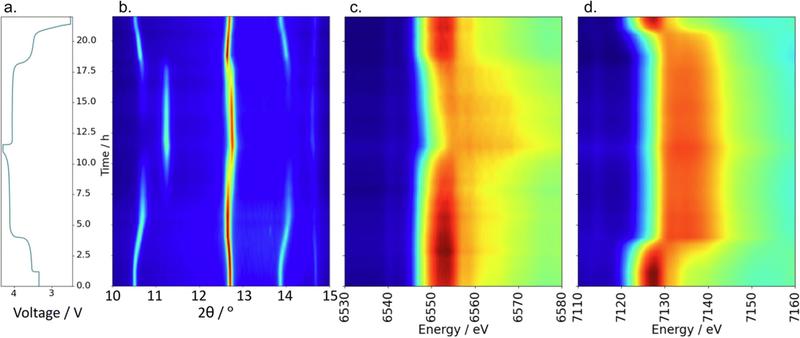
A team of researchers led by Oxford Materials, looked at olivine-type phosphates LiMnxFe1-xPo4, which are attracting increasing interest as positive electrode materials for lithium-ion batteries due to their low cost and good electrochemical performance.
The effects of the mixed Mn/Fe composition, however, on lithium intercalation and ion transport are not fully characterised, especially in Mn-rich compositions.
In the paper 'Investigating the asymmetric electrochemical, structural and electronic properties of Mn-rich Li(Mn,Fe)Po4 electrode materials' (published in Journal of Materials Chemistry A), the electrochemical, structural and ion transport properties of Mn-rich LiMnxFe1-xPO4 (x= 0.6, 0.7, 0.8) (LMFP) were investigated using a combination of experimental and materials modelling techniques. Considerable asymmetry in charge/discharge profiles were found, which highlights the complexity of the mixed-metal system. An intricate lithium intercalation mechanism was observed, including both solid solution and two-phase regions. While the Fe/Mn cation disorder caused the oxidation to proceed mostly via a solid solution mechanism, the MN plateau remainrf associated with a two-phase process.
Ab initio simulations indicated that Li+ diffusion occured along one-dimensional channels parallel to the crystallographic b-axis following a curved trajectory, and found favourable Li/Fe and Li/Mn anti-site defect formation. Analysis of the band gaps of the lithiated and delithiated phases revealed that Mn substitution of Fe can improve the electronic conductivity, suggesting asymmetric electronic behavour.

