


Spacer cation design: layered perovskites
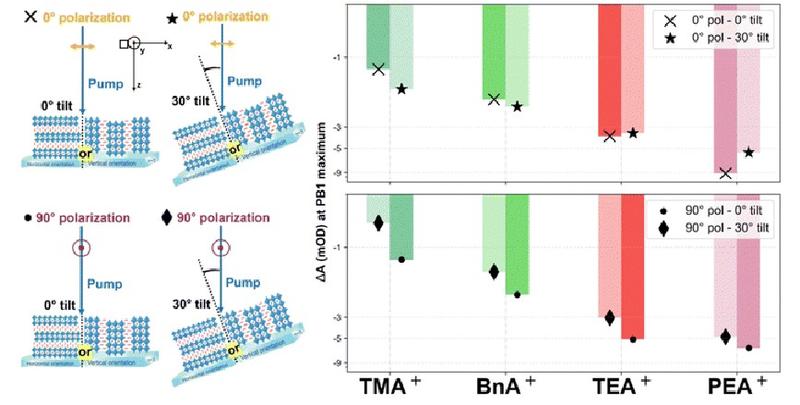
Low-dimensional perovskite halides have recently gained attention as promising materials for stable wide-bandgap solar cells. Controlling their vertical crystal orientation is critical for enabling sufficient charge extraction, but the underlying mechanism remains poorly understood.
In the paper 'Spacer cation design: promoting vertical orientation in layered perovskites', published in EES Solar, DPhil student Tobias Loeff and PostDoc Vikram explain how their atomistic and machine-learning-accelerated work systematically investigates how the interplay between chloride incorporation and spacer cation type dictates the vertical growth of 2D perovskites, providing design principles for enhanced photovoltaic performance.

