


Electrochemical impedance spectroscopy investigation of the SEI formed on lithium metal anodes
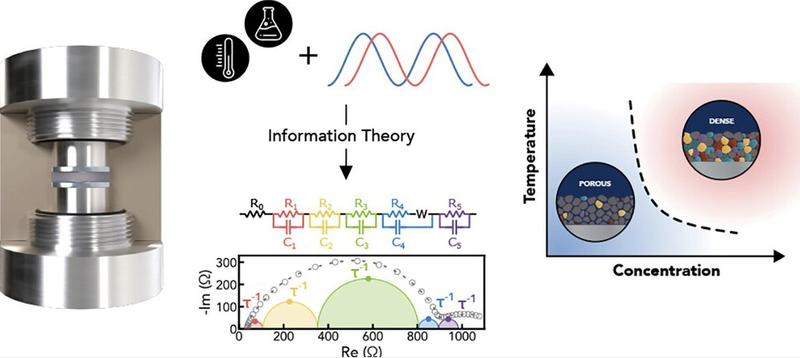
In this paper, published in ACS Electrochemistry, the authors explain how electrochemical impedance spectroscopy (EIS) is widely used to probe the solid electrolyte interphase (SEI) under realistic conditions, without causing damage to its structure. The models and experimental conditions, however, often raise concerns about the reliability of the results.
This paper ('Electrochemical impedance spectroscopy investigation of the SEI formed on lithium metal anodes') presents an extensive EIS study of lithium metal in the model electrolyte lithium bis(flurosulfonyl)imide in tetraglyme, analysing the system at equilibrium as a function of time, temperature, and salt concentration using a set-up designed to minimise artifacts. The authors applied information theory to determine the number of independent degrees of freedom and constrain the number of Voigt elements used in fitting.
Their analysis reveals strong correlations among processes, warranting caution when assigning physical meaning. X-ray spectroscopy and 4D scanning transmission electron microscopy measurements were used to support the interpretation and provide complementary insights into the chemical nature of the interphase. The unique and extensive dataset collected by the authors, comprising over 12,000 highly reproducible impedance spectra, will serve as a valuable resource to the community for further analysis, and for supporting additional modelling and experimental efforts.

