


MP001 - Designing Electrolytes from the Ground Up: Linking Solvation, Transport and Interphases
The electrolyte is a critical component of any battery chemistry. It governs rate capability, stability, safety, and ultimately cycle life. As battery technologies move beyond conventional lithium-ion systems towards lithium metal and other high-energy chemistries, electrolyte design has become one of the central scientific challenges in electrochemical energy storage.
While data-driven approaches are increasingly used to accelerate electrolyte discovery, progress is currently limited by a lack of fundamental understanding of how bulk electrolyte properties translate into interfacial and interphase behaviour [1,2]. In particular, the relationship between solvation structure, transport and thermodynamic properties, electrified interface structure, and the formation and function of the solid electrolyte interphase (SEI) remains poorly understood [3].
This DPhil project aims to establish direct links between electrolyte bulk structure and interphase structure. The student will synthesise and systematically modify electrolyte components (salts and solvents), with the goal of tuning solvation environments and transport properties in a controlled manner. These electrolytes will then be characterised using advanced electrochemical and spectroscopic techniques to correlate bulk physicochemical properties with interphase composition, nanostructure, and electrochemical performance. The overarching objective is to move from empirical electrolyte optimisation to knowledge-driven electrolyte design, grounded in mechanistic understanding.
The ideal candidate will have a strong background in Chemistry, ideally with a Master’s project involving synthetic organic chemistry.
This project is fully funded and is open to both Home and Overseas fees students. The 3.5-year studentship will provide course fees and a stipend of at least £21,805 per year (pro-rata for the final six-months).
References
[1] Zhao, J., Jagger, B., Sun, S., Xu, Y. & Pasta, M. Operando Raman Gradient Analysis for data-driven electrolyte discovery. ChemRxiv (2025) doi:10.26434/chemrxiv-2025-rvxkb.
[2] Jagger, B. & Pasta, M. Solid electrolyte interphases in lithium metal batteries. Joule 7, 2228–2244 (2023).
[3] Olbrich, L. F. et al. Electrochemical impedance spectroscopy investigation of the SEI formed on lithium metal anodes. ACS Electrochem. 2, 166–174 (2026).
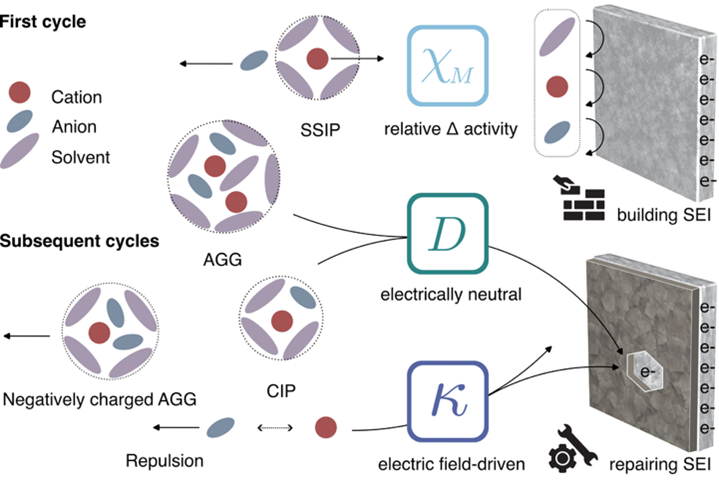
Linking solvation, transport and interphases [1].

