


Cathode materials and machine-learning interatomic potentials
While nickel-based layered oxide cathodes offer promising energy and power densities in lithium-ion batteries, they suffer from instability when fully delithiated upon charge. Ex situ studies often report a structural degradation of the charged cathode materials, but the precise mechanism is still poorly understood on the atomic scale.
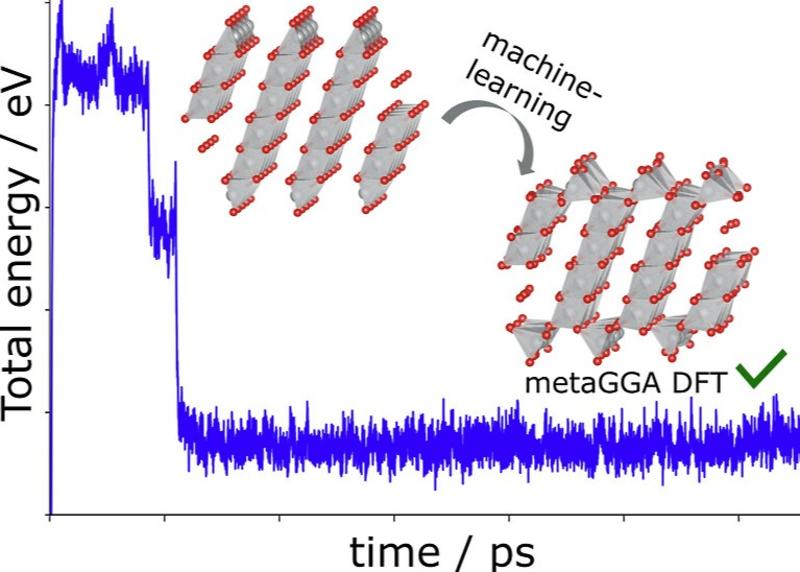
In the paper 'Probing surface degradation pathways of charged nickel-oxide cathode materials using machine-learning interatomic potentials', published in Surfaces, Interfaces, and Applications, the authors combine high-level ab initio calculations with molecular dynamics using machine-learning interatomic potentials to study structural degradation of fully delithiated LiNiO2 surfaces at the top of charge.
The authors explain how they find a previously unreported, stable, reconstruction of the (012) facet with more facile oxygen loss compared to the pristine surfaces. The oxygen vacancy formation energy closely corresponds to the experimental decomposition temperatures of charged cathodes. Molecular dynamics simulations were used to sample Ni ion migration into alkali-layer sites, which is a kinetically plausible initiation step for surface degradation toward thermodynamically stable products.

