

MY006 - From Reactor to Interface: Uncovering the Mechanisms of Li-Mediated Electrochemical Ammonia Synthesis
Electrochemical ammonia synthesis offers a promising route to producing NH₃ using renewable electricity under milder conditions than the conventional Haber-Bosch process. [1,2] Among emerging approaches, Li-mediated nitrogen reduction has demonstrated high selectivity and promising production rates, [1,2] but its energy efficiency remains limited and the fundamental mechanisms controlling performance are still poorly understood.
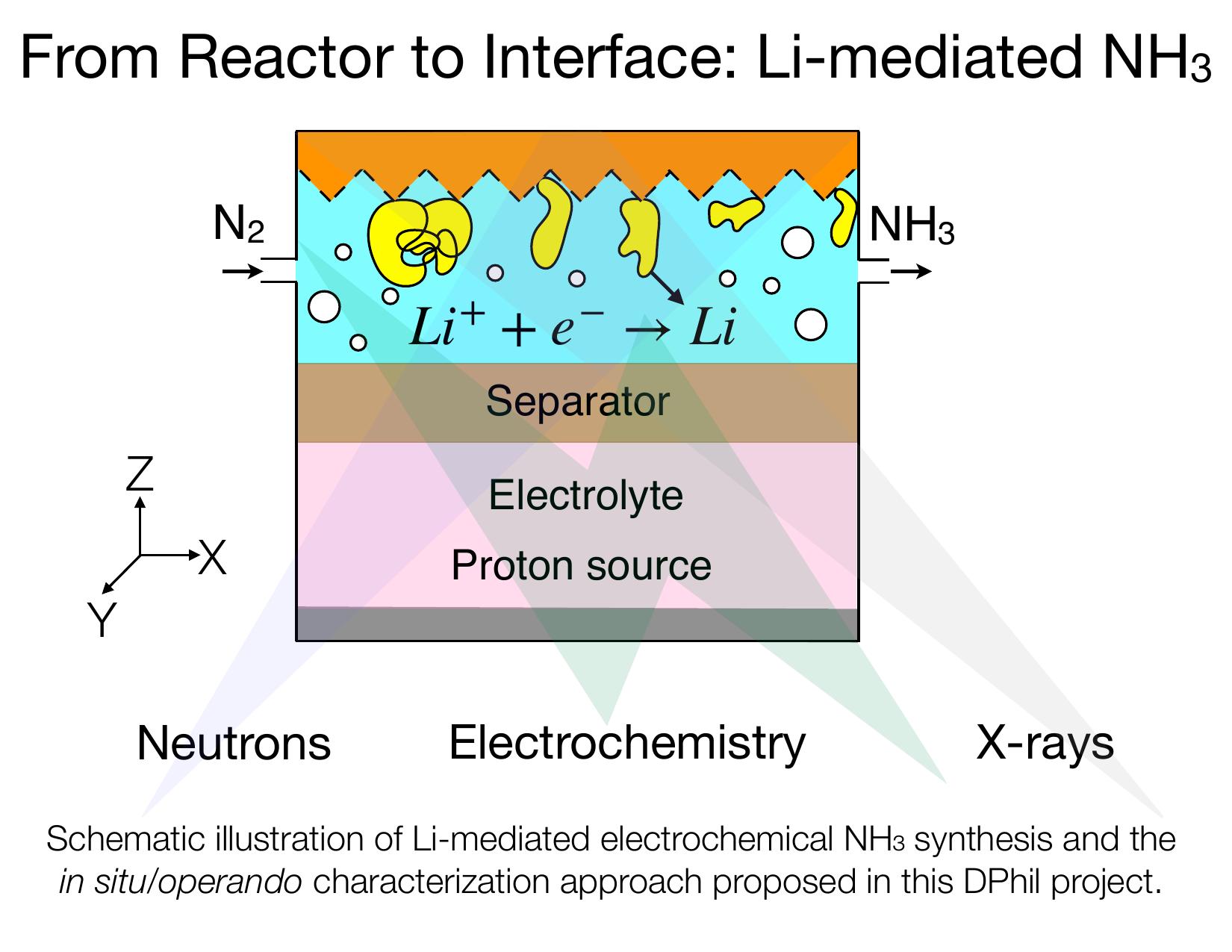
This DPhil will investigate how ionic transport, Li deposition, interfacial chemistry, and reactor conditions govern the efficiency and selectivity of Li-mediated ammonia synthesis. The student will develop and characterize an electrochemical reactor for quantitative NH₃ synthesis and establish robust relationships between operating conditions, electrochemical performance, and reaction outcomes.
Advanced in situ and operando characterization will then be used to probe the evolving electrode-electrolyte interface under reaction conditions. Building on our previous development of simultaneous neutron and X-ray tomography [3] and neutron-friendly electrochemical cells for in situ 3D visualization of Li, [4] neutron and X-ray methods will provide complementary information on Li distribution, morphology, spatial heterogeneity, and structural evolution [5]. Operando spectroscopy will provide complementary information on interfacial chemistry. [6] These measurements will be correlated with electrochemical performance to identify the physical and chemical processes limiting efficient ammonia production.
The project sits at the interface of chemical engineering and materials science and is particularly suited to a student with strong quantitative training and an interest in electrochemistry, reaction engineering, and advanced materials characterization.
Funding
This project is fully funded and is open to Home-fee-status students.
References
1. Burdis, C. et al. “Recent advances in metal-mediated electrochemical ammonia synthesis towards commercialization.” Current Opinion in Green and Sustainable Chemistry 50 (2024), 100964.
2. Du, H. L. et al. “Electroreduction of nitrogen with almost 100% current-to-ammonia efficiency.” Nature 609 (2022), 722–727.
3. Yusuf, M. et al. “Simultaneous neutron and X-ray tomography for visualization of graphite electrode degradation in fast-charged lithium-ion batteries.” Cell Reports Physical Science 3 (2022).
4. Yusuf, M. et al. “Neutron-friendly Li-ion battery coin cell for in situ 3D visualization of Li plating.” Journal of The Electrochemical Society 172 (2025), 090531.
5. Kasemchainan, J. et al. “Critical stripping current leads to dendrite formation on plating in lithium anode solid electrolyte cells.” Nature Materials 18 (2019), 1105–1111.
6. Swallow, J. E. et al. “Revealing solid electrolyte interphase formation through interface-sensitive operando X-ray absorption spectroscopy.” Nature Communications 13 (2022), 6070.