


TEW003 - Understanding the limits of novel Refractory Superalloys
Reducing the emissions from long haul flights will require hotter, more efficient aeroengines, but current operating temperatures are limited by the materials used in the harshest regions within the engine. Nickel-based superalloys, the current material of choice for the high-temperature and high pressure region of aeroengines, are approaching their fundamental temperature limit. Refractory metal high entropy superalloys (RSAs) have been heralded as having the potential to supersede nickel-based superalloys, comprising high melting temperature elements such as Ta, Mo, Nb and Zr, exhibited superior strengths at elevated temperatures and comparable densities to nickel-based superalloys. This high temperature strength is thought to arise from the finescale microstructure that forms within RSAs, akin to the fcc-gamma prime microstructure of Nickel-based superalloys, comprising of a disordered bcc phase and a coherent ordered B2 superlattice phase.
It is crucial that a beneficial microstructure for high temperature strength can be produced and maintained over the duration of the components service lifetime whilst also incorporating sufficient proportion of elements such as Al or Cr that a protective scale can form during oxidation. The B2 phase which is believed to be related to the metastable ternary AlTi2(Mo,Ta) phase. The finescale B2+bcc microstructure has been shown to form through a spinodal decomposition followed by an ordering transformation, but whether the B2 phase forms stably in these more compositionally complex systems is not well documented. Some studies indicated that increased Al content enables the B2 phase to remain stable at higher temperatures. Furthermore, their microstructures can coarsen or exhibit rapid formation of deleterious intermetallic phases and are sensitive to impurities such as O and N. For use in high temperature structural applications, these alloys will need to retain both their high temperature mechanical strength and provide sufficient oxidation resistance.
This project will use alloy series with systematically varying composition to explore the limits of B2-bcc stability, with temperature, composition and how impurities impact alloy performance. The temperature the B2 phase forms and how it evolves with extended thermal exposure will be assessed with a variety of techniques such as in-situ high temperature TEM or XRD, DSC and SEM EDX, to determine the upper operational temperatures for these alloys, driving factors for coarsening, their thermal stability and how compositional modification can improve their performance. Advanced characterisation techniques will be used to assess the segregation of impurities and how this effects mechanical properties, to inform the development of the next generation of refractory superalloys.
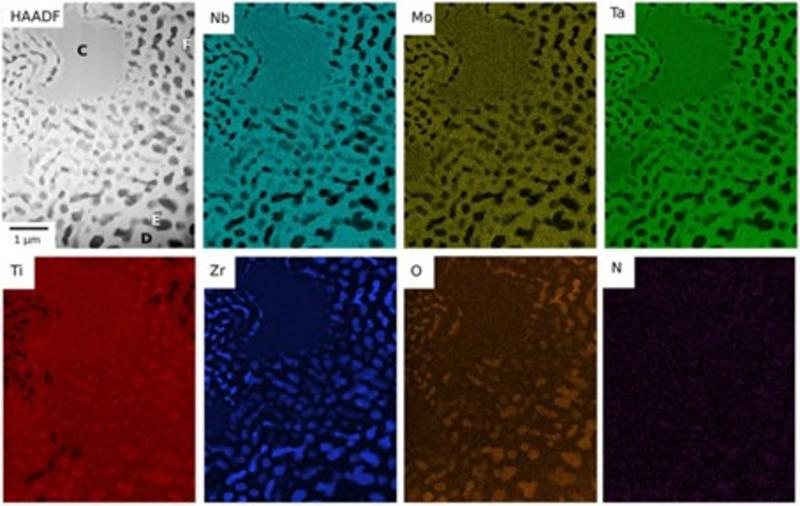
Microstructure of a high O content model refractory superalloy, with O stabilised phases
(Whitfield et al., Scripta Mater, 2020, 180, 71-76)

