

SCS003 - Neutron irradiation of high-temperature superconductors for fusion magnets
High-temperature superconducting (HTS) magnets are enabling a new generation of compact fusion reactor designs. Rare-earth barium copper oxide (REBCO) superconductors can generate exceptionally high magnetic fields, but in a fusion reactor they will be exposed to an intense flux of high-energy neutrons. Understanding how this radiation affects their superconducting properties is therefore critical to determining the performance and lifetime of future fusion magnets.
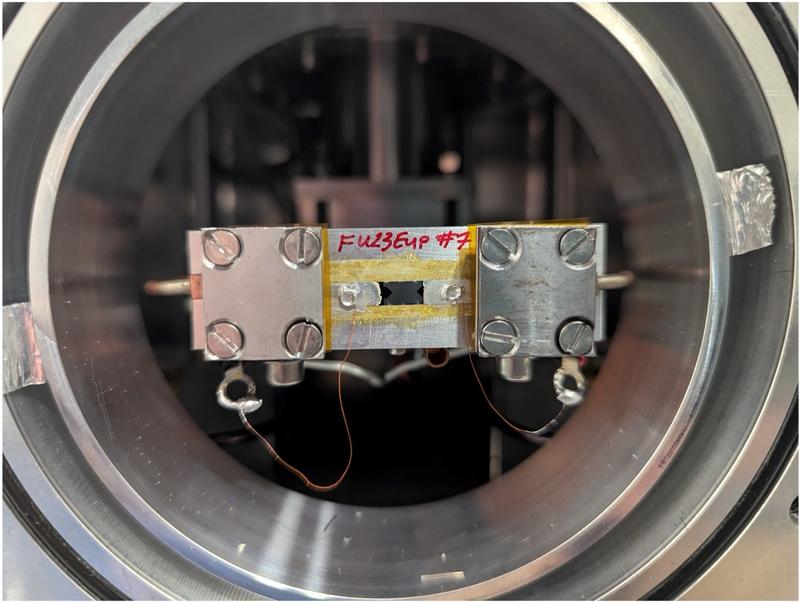
Most previous neutron irradiation studies have measured superconductors only after they have been warmed back to room temperature. However, radiation-induced defects can partially recover during warming, meaning that these experiments may not reveal how the material actually behaves inside an operating cryogenic magnet. This project will use a unique experimental system at the NILE D–T fusion neutron source at ISIS to study REBCO superconductors in situ during neutron irradiation at cryogenic temperatures.
Building on preliminary experiments that have already demonstrated measurable neutron-induced degradation, the student will investigate how fusion-spectrum neutrons alter the critical current and superconducting properties of commercially relevant REBCO coated conductors. Experiments will be extended to include applied magnetic fields, allowing irradiation effects to be studied under conditions increasingly representative of a fusion magnet.
A second strand of the project will explore whether individual neutron interactions can cause transient disruption of superconductivity. The student will fabricate narrow, meandering superconducting devices inspired by superconducting nanowire photon detectors, designed to be extremely sensitive to local energy deposition from neutron collisions. This could provide new insight into the fundamental interaction between energetic radiation and the superconducting state and potentially lead to a new type of cryogenic neutron detector.
The project combines superconductivity, fusion materials, radiation physics and device fabrication, with experiments spanning cleanroom microfabrication, low-temperature and high-field electrical measurements, neutron irradiation and high-speed signal detection. The student will work between the University of Oxford and ISIS, with access to expertise and facilities in both the Oxford Superconducting Materials group and the NILE neutron irradiation team.