

TJM001 - Critical Crack Fields for Hydrogen-assisted Fracture in Steels
Hydrogen causes embrittlement of steels. This has been a critical issue in many industries, and there is renewed interest in hydrogen-assisted cracking due to the increasing importance of hydrogen as a clean fuel. There is still debate on how hydrogen affects interatomic cohesion and plasticity to cause cleavage fracture, despite at least 100 years of scientific experimental and modelling studies. One of the challenges to the verification of the many embrittlement models is the lack of observations of the local strain fields that actually cause crack propagation.
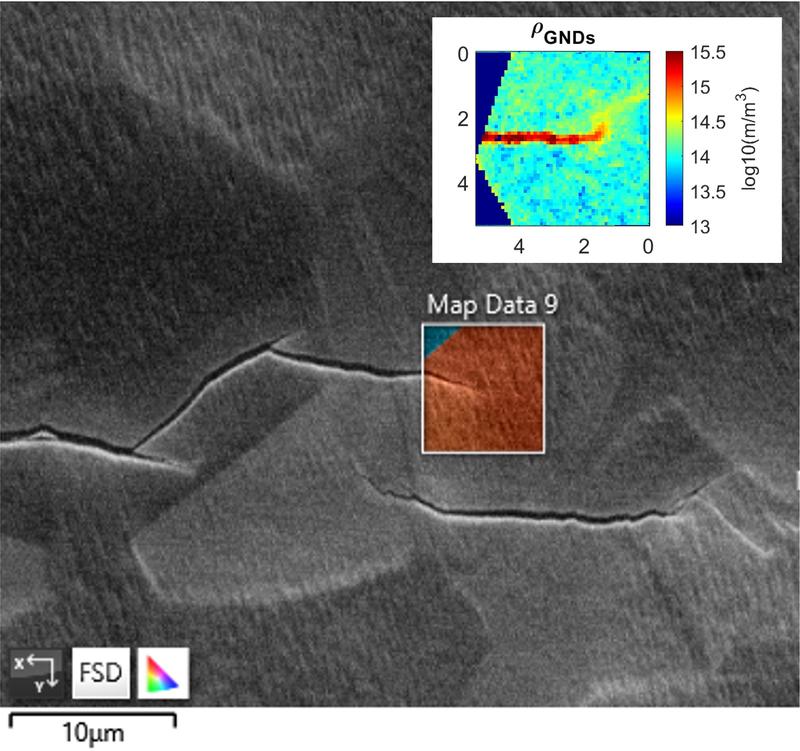
New characterisation techniques bring opportunities for new insights (https://doi.org/10.1016/1359-6454(95)00429-7), and it is now possible to directly measure and evaluate the local strain fields of cracks in bulk materials by high resolution electron backscatter diffraction (HR-EBSD). (https://doi.org/10.1016/j.actamat.2025.121797). This project aims to use these tools to answer the question "What is the effect of hydrogen on the local conditions for transgranular cleavage in steels?".
The initial focus will be a model material (duplex stainless steel) (https://doi.org/10.1016/j.actamat.2021.117203, https://doi.org/10.1016/S1359-6462(99)00095-0) in which the ferrite phase is embrittled by thermal aging to cause cleavage cracking at room temperature. The project will then move on to structural steels for hydrogen transport and storage. Crack propagation and arrest in controlled residual stress fields (https://doi.org/10.1016/j.msea.2014.11.008) will be induced, with and without the additional influence of hydrogen (https://doi.org/10.1016/1359-6454(95)00429-7). Direct measurement of the critical elastic and plastic strain fields at the crack tip (https://doi.org/10.1016/j.jmps.2022.105173) will, for the first time, allow investigation and direct evaluation of local criteria for cleavage and crack tip plasticity. Such criteria are needed to inform new approaches to mitigate hydrogen embrittlement and its effects (e.g. https://doi.org/10.1007/s10853-017-1978-5).
The project is suitable for graduates with an engineering, mathematical or physical sciences background.