


RSB002: Understanding Energy in Electrochemical Ionic Synapses For Neuromorphic Computing
Interface and Electronic Materials Laboratory
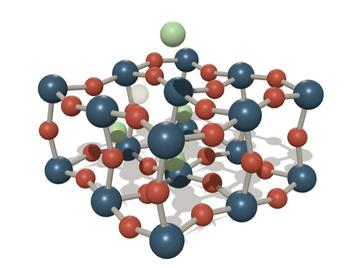
Neuromorphic computing aims to reproduce aspects of neural information processing using physical devices, offering a potential route to more energy-efficient artificial intelligence hardware. Electrochemical ionic synapses are promising candidates because mobile ions can continuously tune their electrical conductance, providing the analogue memory behaviour required for learning and inference. However, the energy consumed during ionic switching, storage, and readout is not yet sufficiently understood. Establishing where energy is stored, dissipated, or lost is therefore essential for improving device efficiency without compromising speed, retention, endurance, or analogue programmability.
This project will determine how material properties and device architecture govern energy use in electrochemical ionic synapses. The student will investigate nanolayer materials whose ionic conductivity enables reversible conductance control. Particular attention will be given to ion mobility, interfacial charge transfer, defect-mediated transport, charge retention and the coupling of electron and ion conduction. Experimental measurements will be combined with physical modelling to connect these processes to the energy consumed during individual synaptic operations.
The project involves: (1) materials characterisation, relating composition, thickness, interfaces, and defect structure to ionic and electronic transport; (2) device fabrication and measurement, producing electrochemical synaptic devices and quantifying their switching energy, speed, retention, endurance, and conductance linearity; (3) energy analysis and modelling, separating the contributions of ionic motion, electrochemical reactions, leakage, and peripheral electrical losses; and (4) device-level benchmarking, evaluating how operating conditions and material choices affect the energy–performance trade-offs relevant to neuromorphic computing.
The work will combine materials synthesis, nanoscale device fabrication, electrical and optical characterisation, data analysis, and multiphysics modelling. Collaboration across materials science, electrical engineering, and device physics will allow measurements at the material level to be linked directly to synaptic behaviour.
The ultimate goal is to establish a predictive framework for designing electrochemical ionic synapses with lower and more controllable energy consumption. The resulting understanding will guide the selection of materials, interfaces, device geometries, and operating protocols for efficient and scalable neuromorphic hardware. The student will gain interdisciplinary expertise spanning functional materials, electrochemical devices, advanced characterisation, and energy-efficient computing.

