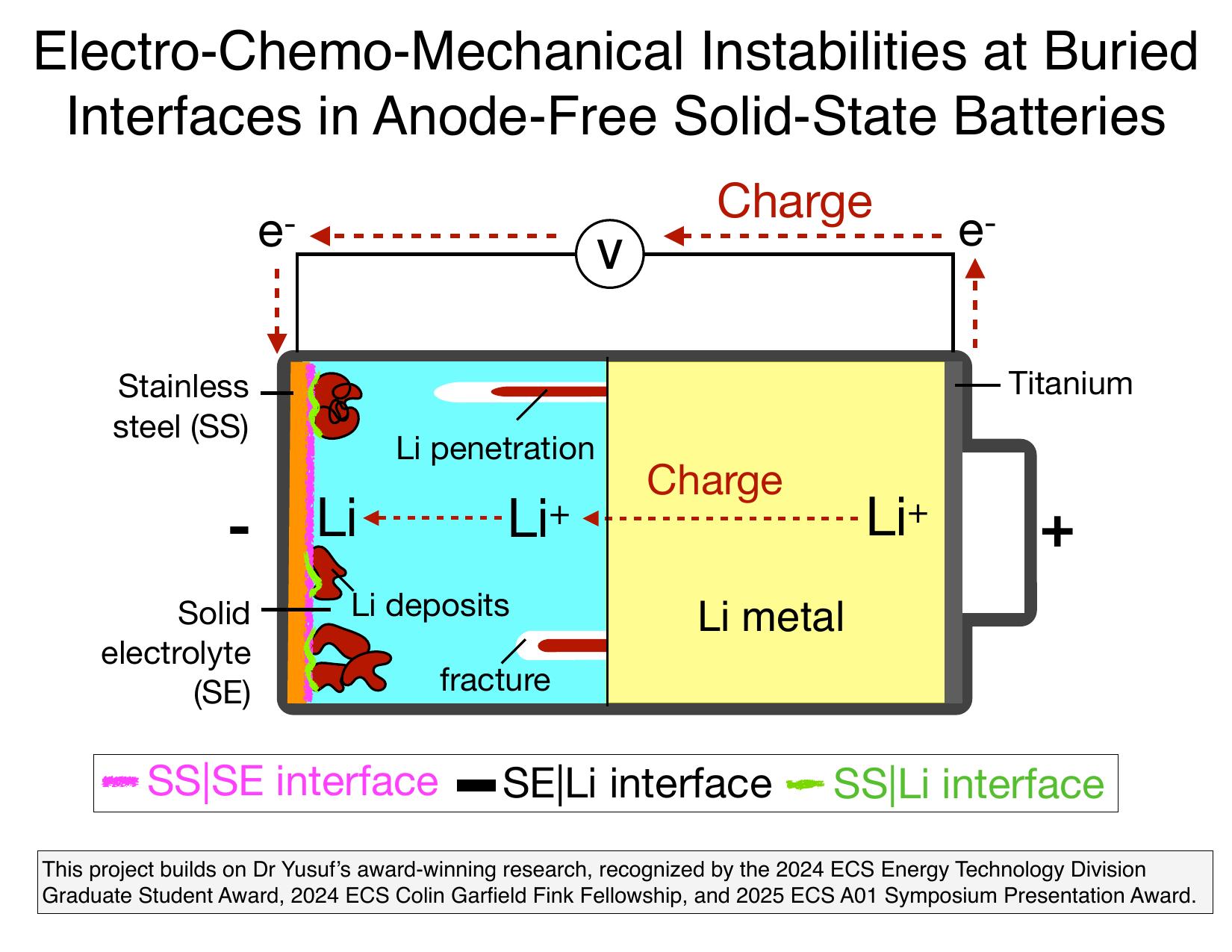


MY004 - Uncovering Electro-Chemo-Mechanical Failure at Buried Interfaces in Anode-Free Solid-State Batteries Using In Situ 3D Neutron and X-ray Imaging
Anode-free solid-state batteries (AF-SSBs), in which lithium (Li) is plated directly onto a current collector (CC) during charging, offer a promising route toward higher-energy-density, safer, and more resource-efficient batteries. However, their practical implementation is limited by severe electro-chemo-mechanical instabilities at buried solid-solid interfaces. [1] Particularly, the three-dimensional (3D) mechanisms linking Li morphology, mechanical degradation, and electrochemical performance remain poorly understood, especially at buried CC|SE interfaces where Li nucleation and plating occur.
This DPhil will establish a mechanistic understanding of how Li plating and stripping drive degradation and failure at buried interfaces in anode-free solid-state batteries. The project will combine quantitative electrochemistry with in situ and operando neutron and synchrotron X-ray imaging to directly visualize Li evolution, fracture formation, strain, and interfacial morphology during battery operation.
The student will develop and validate neutron- and X-ray-compatible AF-SSBs and investigate buried CC|SE, CC|Li, and Li|SE interfaces during cycling. Building on established approaches for in situ and operando 3D neutron and X-ray battery diagnostics, [2-5] neutrons will provide high sensitivity to Li, while X-ray imaging will resolve electrode and solid-electrolyte microstructure and fracture evolution, and X-ray diffraction will probe strain and phase evolution. These measurements will allow Li plating and stripping to be quantified in 3D and correlated directly with changes in interfacial structure, mechanical degradation, and electrochemical performance. The resulting structure-property-performance relationships will be used to identify operating conditions and interfacial designs that promote more spatially uniform and reversible Li plating.
The student may also undertake a short research visit to Princeton University, working with Prof. Craig Arnold.
References
1. Ning, Z. et al. “Visualizing Plating-Induced Cracking in Lithium-Anode Solid-Electrolyte Cells.” Nature Materials 2021, 20, 1121–1129.
2. Yusuf, M.; Cushing, S. “Reports from the Frontier: In Situ 3D Neutron and X-ray Imaging for Battery Diagnostics.” The Electrochemical Society Interface 2025, 34(2), 24. [Invited ECS Perspective]
3. Yusuf, M. “In Situ Simultaneous Neutron and X-ray Tomography of Solid-Solid Interfaces in Anode-Free Solid-State Batteries.” The Electrochemical Society Interface 2024, 33(4). [ECS Colin Garfield Fink Fellowship 2024]
4. Yusuf, M. et al. “Simultaneous Neutron and X-ray Tomography for Visualization of Graphite Electrode Degradation in Fast-Charged Lithium-Ion Batteries.” Cell Reports Physical Science 2022, 3(11). [2022 Editor’s Choice]
5. Yusuf, M. et al. “Visualizing 3D Morphologies and Spatial Heterogeneities of Li after Fast-Charging via In Situ Neutron Tomography.” ChemRxiv 2024. [2024 ECS Energy Technology Division Graduate Student Award]