

SCS004 - Atomic-resolution imaging of radiation-induced defects in high temperature superconductors for fusion applications
Rare-earth barium copper oxides (REBCO) are the only class of high-temperature superconducting (HTS) materials that have been developed into commercial conductors with an engineering performance good enough for use in the high field magnet for small fusion tokamaks like the one being designed in the STEP programme ( https://ccfe.ukaea.uk/research/step/ ). One of the critical aspects we must understand before deploying these expensive materials in a fusion reactor is how their superconducting properties are affected by exposure to high energy neutrons to ensure that they can retain adequate performance for the lifetime of the magnets. Atomic-resolution imaging and spectroscopy in an aberration-corrected electron microscope can directly reveal the local structure and bonding arrangement associated with lattice defects. However, we have shown that light ion irradiation of REBCO does not greatly affect the cation sublattices that are easily visible with scanning transmission electron microscopy (STEM) using the high-angle annular dark field (HAADF) imaging mode, even in samples that have been irradiated with sufficiently high fluences to lose superconductivity altogether. Therefore, it is believed that damage in the oxygen sublattice is largely responsible for the loss of superconductivity.
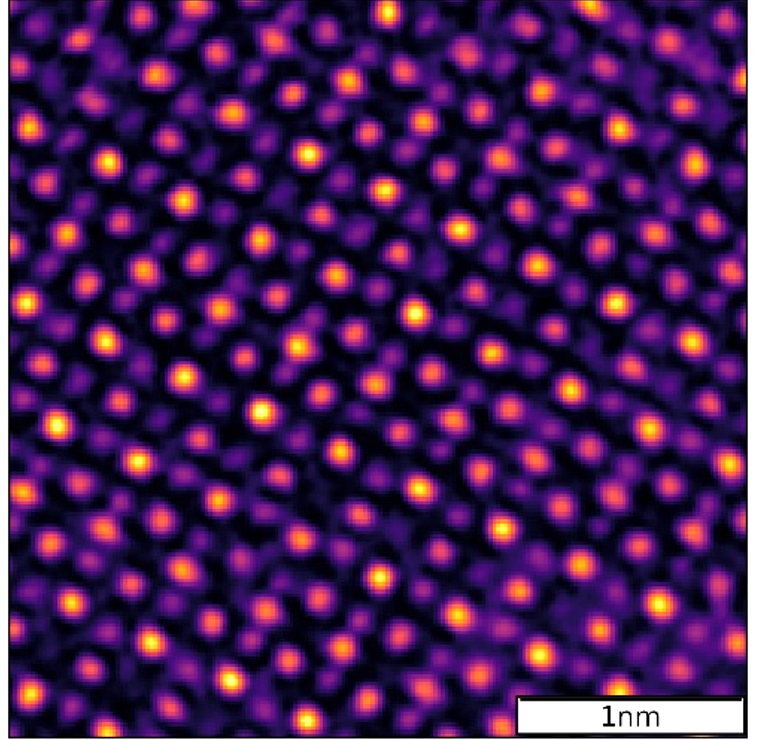
This project will use a STEM technique known as electron ptychography that is an interferometric method related to holography and allows the oxygen atoms, which only weakly scatter electrons so cannot be observed in HAADF mode, to be imaged. The student will build on our preliminary work to identify point defects using this technique, including exploring whether it is possible to extract quantitative information from ptychography data. In addition, atomic-scale strain mapping methods to characterise disorder and structural defects from the images such as stacking faults that are introduced by irradiation will be developed. The project will involve sample preparation and operation of advanced electron microscope instruments followed by data processing and modelling allow a full understanding to be developed.