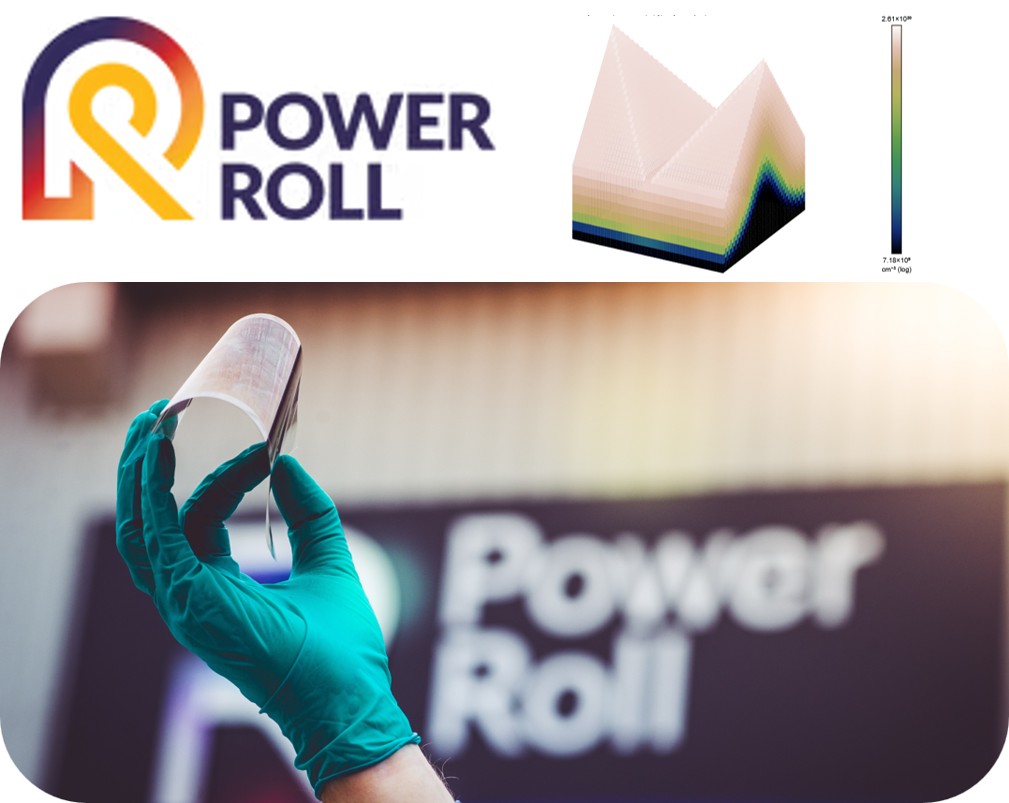
RSB007 - Advanced Characterisation and Device Modelling for Improved Back Contacted Tandem Photovoltaics
Tandem solar cells combine absorbers with complementary bandgaps to convert a greater fraction of sunlight into electricity. Integrating tandem absorbers into back-contacted, flexible devices introduces challenges in optical absorption, carrier collection and interface design. Understanding how these processes interact is essential to identify performance losses and guide improvements in device architecture. This project brings together Oxford Materials and Power Roll UK, aligned with the UKRI Future Leaders Fellowship programme Back-Contacted Flexible Tandem Photovoltaics (BaCT-PV).
The student will develop physics-based numerical models to establish how semiconductor properties, interfaces and contact geometry govern tandem device performance. A central component will be the coupled solution of electrostatic and carrier transport equations, including Poisson’s equation and electron and hole continuity equations, alongside models of optical generation and recombination. Particular attention will be given to band alignment, defect-mediated recombination, charge-selective contacts and lateral carrier transport in back-contacted architectures. The models will be used to distinguish competing loss mechanisms and assess experimentally testable changes to materials and device design.
Computational work will be closely linked to electrical and optoelectronic characterisation. Current–voltage measurements, spectral response and photoluminescence, including measurements under varying temperature and illumination, will provide evidence for parameter extraction and model validation. Comparing simulations with measured behaviour will establish which physical processes limit performance and how these evolve during device operation and degradation.
The project requires a candidate willing to engage deeply with solid-state physics and the numerical simulation of semiconductor devices. The student should be motivated to understand the governing equations, assess their physical assumptions and develop reliable computational solutions. Strong analytical skills and an interest in scientific programming are important; previous experience in semiconductor modelling would be beneficial, with training provided in the relevant methods.
The collaboration will connect fundamental research at Oxford Materials with Power Roll’s development of lightweight, flexible photovoltaic films for scalable manufacturing. The aim is to establish validated models and characterisation methods that guide the design of more efficient and stable back-contacted tandem solar cells.