RSW007 - Revealing the Role of Cross-talk in LMFP Battery Degradation
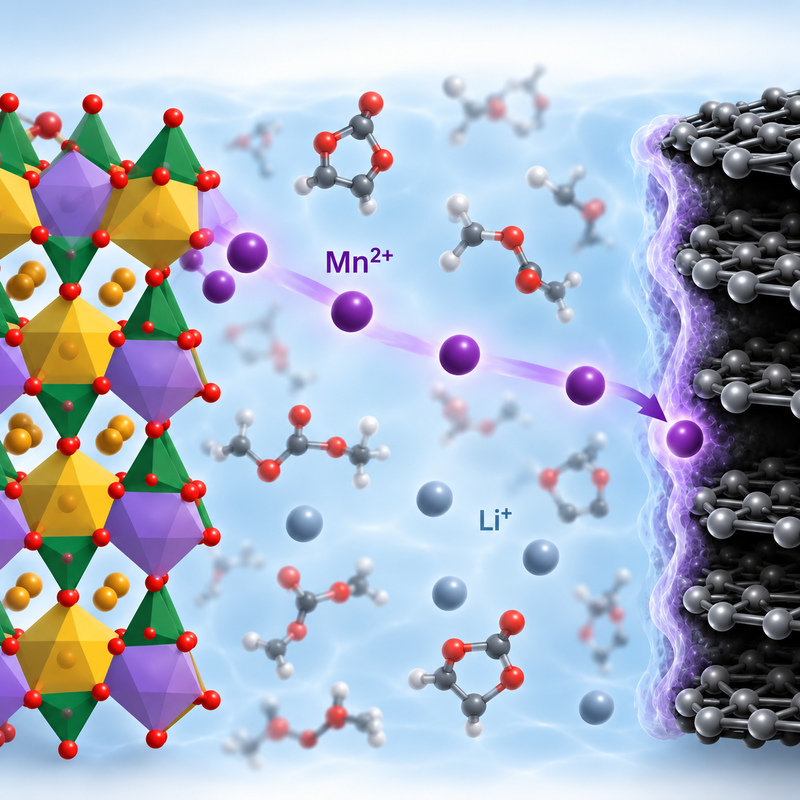
Rechargeable lithium-ion batteries are central to the electrification of transport, but increasing demand is placing pressure on the supply of critical raw materials. Lithium manganese iron phosphate (LMFP) is a promising next-generation cathode material that combines the low cost and sustainability advantages of lithium iron phosphate (LFP) with a higher operating voltage and therefore increased energy density. However, introducing manganese can reduce battery lifetime through dissolution of Mn from the cathode and its subsequent transport through the electrolyte to the anode.
This electrode “cross-talk” can trigger complex degradation processes, with dissolved Mn and other species altering the solid electrolyte interphase (SEI), leading to loss of cyclable lithium, increasing resistance and ultimately capacity fade. Understanding these processes is challenging because degradation involves coupled reactions occurring at both electrode surfaces and within the electrolyte.
This DPhil project aims to reveal the mechanisms responsible for cross-talk and degradation in LMFP–graphite batteries and use this understanding to develop strategies for improving their lifetime. You will investigate how factors including cycling voltage, rate and temperature influence Mn dissolution, determine how Mn and other cross-over products affect the stability of the SEI, and explore electrochemical strategies for suppressing these unwanted reactions.
The project will combine Li-ion battery preparation and electrochemical methods with advanced analytical techniques to investigate degradation products in the solid, liquid and gas phases. Particular emphasis will be placed on X-ray photoelectron spectroscopy (XPS) and X-ray absorption spectroscopy (XAS) to probe changes in the chemistry of the electrode interfaces. These measurements will include experiments at synchrotron facilities such as Diamond Light Source and MAX IV, with opportunities to perform advanced operando measurements that directly follow key interfacial reactions during battery operation.
The project will be jointly supervised by Prof Robert Weatherup at the University of Oxford and Prof Julia Maibach at Chalmers University of Technology. The student will spend the second year of the DPhil based at Chalmers in Gothenburg, Sweden, before returning to Oxford for the third year.
By establishing how cross-talk links reactions at the cathode and anode, the project aims to identify the processes responsible for rapid capacity fade and determine how they can be avoided, helping to guide the development of longer-lived LMFP batteries and other sustainable Mn-rich battery chemistries.
Funding
This project offers a three-year funded studentship and is available to Home fee status applicants.
Any questions concerning the project can be addressed to Prof Robert Weatherup (robert.weatherup@materials.ox.ac.uk) and Prof Julia Maibach (julia.maibach@chalmers.se).