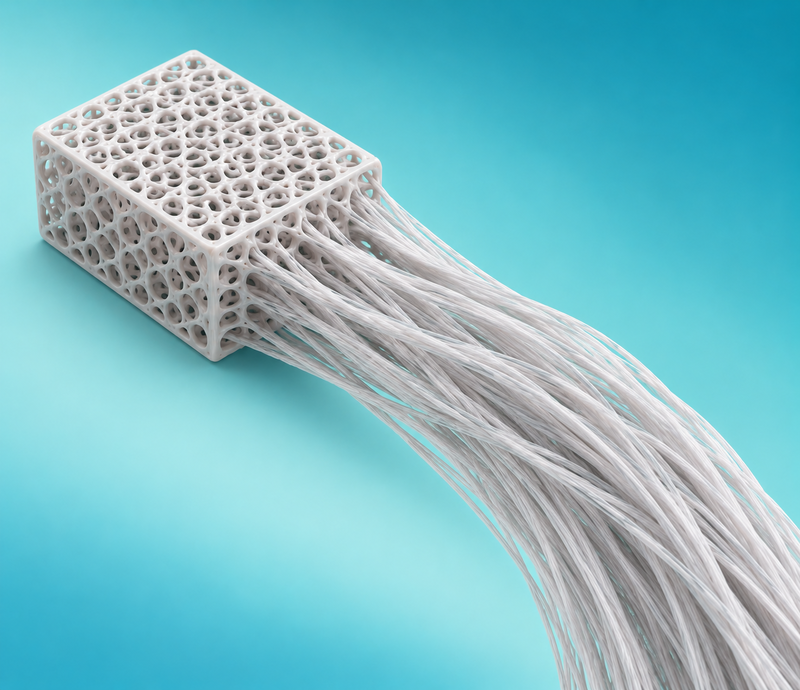


PAM006 - A graded soft-to-hard scaffold for tendon-to-bone interface regeneration
The repair of complex tissue interfaces, such as the enthesis where soft connective tissue transitions into hard bone, remains a major challenge in regenerative medicine. These interfaces exhibit gradual changes in composition, structure and mechanical properties that enable effective load transfer between mechanically dissimilar tissues. Conventional single-material implants, and even biphasic constructs with distinct soft and hard components, cannot fully reproduce this transition, which can result in stress concentrations, poor tissue integration and compromised function. Building on previous work combining electrospinning and additive manufacturing for tendon-to-bone repair, this project aims to develop a new generation of functionally graded soft–hard composite scaffolds that recreate the transition between these tissues.
The project will establish advanced fabrication strategies for integrating continuous electrospun fibres and yarns within three-dimensional porous scaffolds. Additive manufacturing techniques will be used to fabricate mechanically robust, porous structures suitable for bone regeneration, while aligned electrospun fibres or yarns will provide compliant, tendon-like regions. Rather than creating an abrupt junction between these components, fibres will be selectively woven, embedded or integrated throughout the printed structure to create a mechanically stable soft–hard interface.
A central focus will be the development of graded architectures, in which fibre organisation, material composition, porosity, stiffness and potentially mineralisation are progressively varied across the scaffold. This will enable the creation of structures ranging from highly aligned and compliant soft-tissue regions, through an intermediate reinforced interface, to stiff, porous and mineralised bone-like regions.
The resulting scaffolds will be systematically characterised to establish relationships between fabrication parameters, microstructure and function. Structural organisation and interfacial integrity will be evaluated alongside tensile, interfacial and cyclic mechanical performance. Particular attention will be given to determining whether graded architectures improve load transfer and reduce stress concentrations compared with conventional biphasic soft–hard scaffolds. Biological evaluation will assess cell attachment, viability and region-specific tissue formation across the engineered interface.
This research will establish new design and manufacturing principles for graded, multifunctional soft–hard materials. Ultimately, the project aims to provide a versatile biofabrication platform for next-generation implants targeting tendon-to-bone repair and other challenging musculoskeletal interfaces.