


Geometric constraint on residue phases
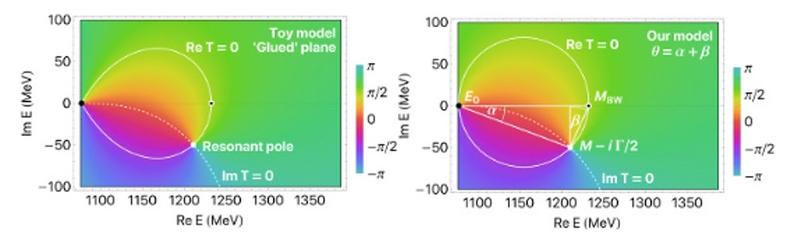
In the paper 'Geometric constraint on residue phases: resolving the N(2190) anomaly and implications for exotic states' as published in Physics Letters B, the authors introduce a simple, parameter-free 'geometry rule' that links a resonance phase (a quality extracted from scattering data) to where the resonance sits relative to the nearest reaction threshold in the complex-energy plane.
Essentially, the position of a resonance should geometrically constrain the phase you are allowed to measure. Using the long-standing N(2190) 'anomalous' case as a stress test, they demonstrate that the problem was not new physics, but a sign-convention ambiguity in a widely used extraction.
Once corrected, the residue phase became consistent with the geometric prediction and a revised world average. This matters beyond baryon spectroscopy: the same check can act as a diagnostic when assessing newly reported 'exotic' hadron candidates, helping distinguish genuine impact resonances from extended structures or kinematic artifacts.

