GDM006 - Decoding antiferromagnetism with light: towards nanoscale optical readout
Can we use light to design and read magnetic information at the nanoscale? This project will investigate how advanced optical techniques and quantum materials engineering can be combined to control and detect antiferromagnetic states, enabling new approaches to harness magnets through enhanced light-matter interactions.
Motivation: Antiferromagnets are an emerging class of quantum materials that could enable future information technologies. They host exceptional properties, including robust magnetic states, extremely fast dynamics and negligible stray fields. These properties unlock exciting opportunities for compact, high-speed and energy-efficient information processing. Recent advances have demonstrated that light can be used to manipulate and design antiferromagnetic order, opening new possibilities for optically programmable antiferromagnetic devices. However, a major challenge remains: how can we reliably read the information encoded in antiferromagnets? Antiferromagnets have a unique configuration containing anti-parallel spins. This makes conventional magnetic detection difficult, motivating new optical approaches that can reveal otherwise hidden magnetic order.
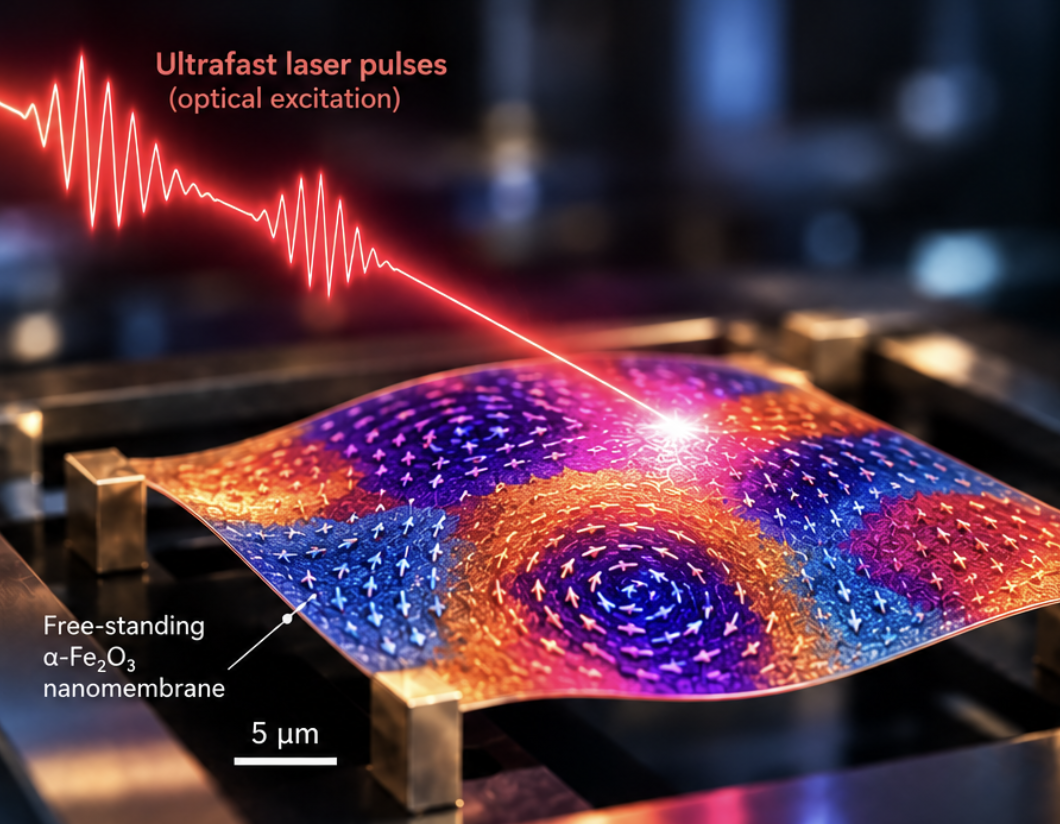
Project Scope: A central aim is to develop new pathways to read out antiferromagnetic states and excitations with nanoscale precision using light. This project will initially focus on α-Fe2O3 (hematite), a model antiferromagnetic oxide with a rich landscape of magnetic phases, spin excitations, and topological textures.
You will learn to design high-quality antiferromagnetic films and freestanding membranes. These engineered materials will provide a platform for investigating how distinct antiferromagnetic configurations influence optical responses. Using advanced optical microscopy and spectroscopy, including scattering, luminescence, linear and nonlinear optical techniques, you will investigate how light interacts with magnetic, electronic and vibrational degrees of freedom. Building on these insights, the project will explore plasmonically enhanced optical techniques to push the sensitivity and spatial resolution of antiferromagnetic detection to the nanoscale limit.
The project sits at the intersection of materials science, condensed-matter physics, ultrafast and nonlinear optics, plasmonics and spintronics. You will gain interdisciplinary training across the full experimental cycle: from engineering thin films and membranes to advanced optical spectroscopy, nonlinear optical microscopy and ultrafast measurements.
The project will combine the complementary expertise of the Jani group in quantum materials design, thin-film growth and magnetic-state engineering with the Di Martino group in nanoscale, nonlinear and ultrafast optical characterisation. Di Martino group has pioneered the optical interrogation of matter at the nanoscale, leveraging plasmonic light confinement to reveal otherwise inaccessible light–matter interactions and local material properties [Nature Electronics (2020), Advanced Materials (2022), Advanced Functional Materials (2023)]. The Jani group has pioneered the discovery and control of nanoscale antiferromagnetism at room temperature, by leveraging quantum materials engineering [Nature (2021), Nature Materials (2024a), Nature Materials (2024b)].
Impact: The project will explore both the fundamental physics of light-matter interactions in antiferromagnets and their potential technological implications. Ultimately, understanding how magnetic states can be controlled and detected with nanoscale precision using light. This will enable new approaches to ultrafast and low-energy information technologies, with potential applications in spintronics, magnetic memory and unconventional computing.
Who are we looking for: We are looking for highly motivated applicants from physics, materials science or related disciplines, with a strong academic track record, solid communication skills and strong exposure to hands-on research. You do not need to have experience in all of the above areas of research, but you should be ready to learn on the go. Curiosity, creativity and passion for interdisciplinary experimental research are most important.