

MY001 - Beyond Lithium: New Metal Chemistries for Electrochemical Ammonia Synthesis
Developing sustainable routes to activate abundant and highly stable molecules such as N₂ is a major challenge in modern chemistry. Li-mediated electrochemical ammonia synthesis has emerged as a promising approach, but the highly negative potential required for Li deposition motivates the search for alternative metal mediators. Recent advances in room-temperature Ca electrodeposition and understanding of Ca plating behavior [1], together with demonstrations of molecular N₂ activation by low-valent Ca [2] and Ca-mediated electrochemical ammonia synthesis [3], suggest an exciting opportunity to develop new metal-mediated chemistries for sustainable NH₃ synthesis.
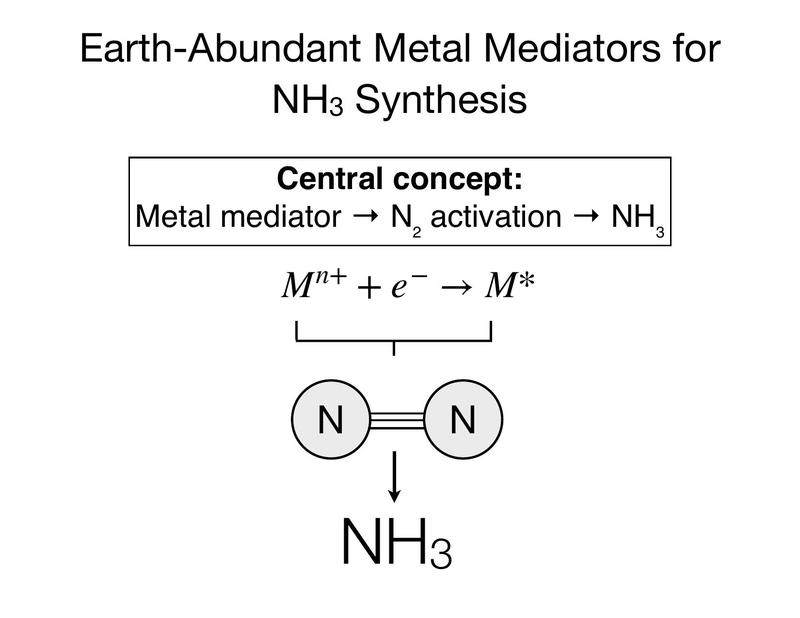
This DPhil will investigate the inorganic and organometallic chemistry of earth abundant metal mediators for electrochemical ammonia synthesis. The central aim is to understand how metal identity, oxidation state, coordination environment, and redox chemistry govern N₂ activation and subsequent reaction pathways. The project will draw on emerging main-group electrochemistry [4] and alkaline-earth nitride chemistry [5] to explore metals and molecular environments beyond conventional Li mediated systems.
The student will develop and characterize new metal-based systems and investigate their reactivity toward N₂ under chemical and electrochemical conditions. The project will combine inorganic and organometallic synthesis with electrochemistry and advanced in situ/operando characterization [6,7]. This project is particularly suited to a student with a strong background in inorganic, organometallic, or synthetic chemistry who is interested in expanding into electrochemistry, in situ/operando characterization, and sustainable chemical synthesis.
References
1. Wang, D. et al. “Plating and stripping calcium in an organic electrolyte.” Nature Materials 17 (2018), 16–20.
2. Rösch, B. et al. “Dinitrogen complexation and reduction at low-valent calcium.” Science 371 (2021), 1125–1128.
3. Fu, X. et al. “Calcium-mediated nitrogen reduction for electrochemical ammonia synthesis.” Nature Materials 23 (2024), 101–107.
4. Ould, D. M. C. et al. “Sodium Tetrakis(hexafluoroisopropyloxy)aluminates: Synthesis and Electrochemical Characterisation of a Room-Temperature Solvated Ionic Liquid.” ChemElectroChem 11 (2024), e202300381.
5. Gál, Z. A., et al. “Synthesis and Structure of Alkaline Earth Silicon Nitrides: BaSiN₂, SrSiN₂, and CaSiN₂.” Inorganic Chemistry 43 (2004), 3998–4006.
6. Yusuf, M. et al. “Neutron-Friendly Li-Ion Battery Coin Cell for In Situ 3D Visualization of Li Plating.” Journal of The Electrochemical Society 172 (2025), 090531.
7. Yusuf, M. et al. “Simultaneous neutron and X-ray tomography for visualization of graphite electrode degradation in fast-charged lithium-ion batteries.” Cell Reports Physical Science 3 (2022), 101145.