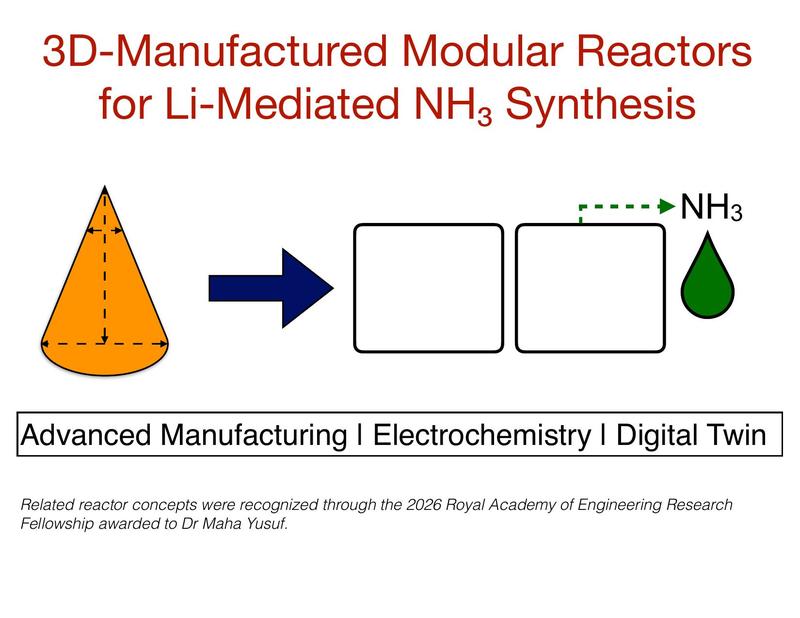


MY002 - 3D-Manufactured Modular Reactors for Li-Mediated Ammonia Synthesis
Electrochemical ammonia synthesis offers a promising pathway towards distributed, renewable production of NH₃. Recent advances in continuous Li-mediated ammonia synthesis demonstrate the potential of this chemistry, while also highlighting the importance of reactor engineering in translating high electrochemical performance towards practical operation.[1]
This DPhil will investigate how advanced manufacturing can be used to create new modular electrochemical reactor architectures for Li-mediated ammonia synthesis. The central focus will be the design and fabrication of three-dimensional reactor components and structured electrochemical interfaces, establishing relationships between manufactured architecture, transport, and reactor performance.
Building on expertise in micro- and nanofabrication, [2] advanced materials manufacturing, [3,4] and electrochemical modeling, [5] the student will combine 3D manufacturing with quantitative electrochemical testing and computational design. Experimental measurements will be used to understand how reactor-scale structure influences electrochemical behavior and to guide subsequent generations of manufactured devices.
Computational models and digital-twin approaches will complement the experiments by linking physical reactor architecture with transport and electrochemical response. Data-driven and machine-learning methods may also be explored as tools for navigating complex design spaces and accelerating optimization. The exact reactor geometries, manufacturing strategies, and modeling framework will be developed during the DPhil.
The project will bring together the Yusuf Group’s expertise in electrochemistry and interfacial characterization, Prof Patrick Grant’s expertise in advanced manufacturing and materials processing, and Prof Paul Shearing’s expertise in electrochemical engineering, modeling, and advanced characterization.
The project is particularly suited to a student with a background in materials science, chemical engineering, mechanical engineering, manufacturing, or micro/nanofabrication who is interested in electrochemical devices and sustainable chemical production.
References
1. Li, S. et al. “Long-term continuous ammonia electrosynthesis.” Nature 629 (2024), 92–97.
2. Yusuf, M. et al. “Optimized Deep Reactive-Ion Etching of Nanostructured Black Silicon for High-Contrast Optical Alignment Marks.” ACS Applied Nano Materials 4 (2021), 7047–7061.
3. Grant, P. S. et al. “Roadmap on Li-ion battery manufacturing research.” Journal of Physics: Energy 4 (2022), 042006.
4. Lee, S. H. et al. “Spray-Printed and Self-Assembled Honeycomb Electrodes of Silicon-Decorated Carbon Nanofibers for Li-Ion Batteries.” ACS Applied Materials & Interfaces 11 (2019), 603–612.
5. Boyce, A. M., Lu, X., Brett, D. J. L. & Shearing, P. R. “Exploring the influence of porosity and thickness on lithium-ion battery electrodes using an image-based model.” Journal of Power Sources 542 (2022), 231779.