


Personal Homepages
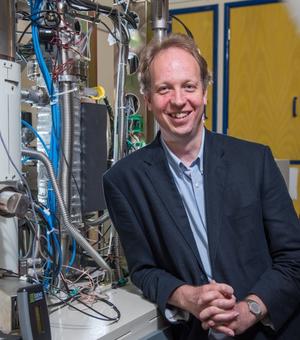
![]() | Professor Peter D Nellist |
Summary of Interests
My research centres on the applications and development of high-resolution electron microscope techniques, in particular scanning transmission electron microscopy (STEM), including atomic resolution Z-contrast imaging, electron energy-loss spectroscopy and applications of spherical aberration correctors. Our technique development work includes methods for the three-dimensional imaging and spectroscopy of materials, and methods to allow high resolution imaging and spectroscopy of radiation sensitive materials. Always we aim to use microscopy data in a quantitative way to make measurements of the atomic and electronic structure of materials.
Current Research Projects
Three-dimensional imaging and analysis through scanning confocal electron microscopy
Dr. P.D. Nellist, Professor A.I. Kirkland, Dr. P. Wang, L. Jones, Professor L. Allen*
The department has installed the world's first electron microscope with aberration correctors in both the condenser (probe-forming) and objective (image forming) lenses. It is possible to use both lens systems together to form a confocal microscope, which allows atomic resolution imaging and analysis in two dimensions simultaneous with nanometre-scale resolution in the third dimension. We are attempting to apply this technique to a diverse range of materials from buried interfaces in semiconductor devices to screw dislocation core structures. (*University of Melbourne, Australia) Funded by Leverhulme Trust.
Quantitative interpretation of aberration-corrected STEM data for the analysis of core-shell nanoparticles
Dr. P.D. Nellist, Dr. S. Lozano-Perez, H. E, Dr. D. Ozkaya*
The development of aberration-correctors for the STEM has led to a dramatic improvement in lateral spatial resolution. Both annular dark-field imaging and spectroscopic methods such as EDX and EELS can provide chemical information at spatial resolutions up to the atomic. We are developing and applying sophisticated methods to quantitatively analysis the data, and applying it to measure segregation and alloying in core-shell bimetallic nanoparticles. Funded by EPSRC and Johnson-Matthey*.
Modelling and quantitative interpretation of electron energy-loss spectra using novel density functional theory methods
Dr. R. Nicholls, Professor P.D. Nellist, Dr. J.R. Yates, Dr. S. Lozano-Perez, Professor N. Grobert, Professor C.R.M. Grovenor, Professor D. McComb*
The research proposed here aims to further our ability to use electron energy-loss spectra to solve real problems in Materials Science by developing new computer modelling methods and by using these methods to study real-world materials problems. Funded by EPSRC.
Low-voltage, low-dose STEM for radiation sensitive materials
Professor P.D. Nellist, G. Theodossiou, Dr. V. Nicolosi, Professor N. Grobert
By the very nature of their length scales, nanoscale materials require imaging and analysis techniques at resolutions approaching individual atoms. Transmission electron microscopy (TEM) can provide such capability. However, many nanoscale materials are also formed from low atomic number materials, such as carbon nanotubes and biological macromolecules, and tend to be damaged by electron beams. Aberration correction in scanning transmission electron microscopy offers an opportunity to image materials with lower electron doses, and electron energy-loss spectroscopy can provide detailed analytical material of lower-atomic number materials. The aim of the project is to develop advanced electron microscope instrumentation and develop strategies for the characterisation of materials with minimum electron exposure. Initial applications of the techniques developed will include B,N-doped carbon nanotubes, novel nanowires and carbon nanotube functionalised by enzymes.
Aberration-corrected electron microscopy for high resolution analysis and imaging
Professor A.I. Kirkland, Dr. P.D. Nellist, Dr. N.P. Young
As part of a major research grant, the Department has secured funding which enables us to work closely with an electron microscope manufacturer in developing the next generation of high performance electron microscopes. The new instrument includes a field-emission-gun, two aberration correctors and various advanced detectors which provide analysis and spatial resolution capabilities at the 1 angstrom level. The instrument is being used for atomic-scale investigations of a range of new materials. (Funded by the Joint Infrastructure Fund)
Functionalisation of MoSI nanowires for composites and molecular interconnects
Dr. V. Nicolosi, Dr. P.D. Nellist, Dr. R. Nicholls, Professor D. Mihailovic*
Nanostructures such as carbon nanotubes have generated much interest in recent years due to their one-dimensional nature and their exciting properties. However, difficulties associated with their lack of dispersability and electronic homogeneity have hindered their incorporation into nanoscale devices. In view of these issues MoSI nanowires (produced in a range of stoichiometries summarised as Mo6S9-xIx) have been receiving growing attention as a viable alternative. One of the major advantages is that MoSI nanowires contain S atoms in their structure, and as such can form covalent bonds to very diverse molecular entities. Connection to gold nanoparticles and thiol-containing proteins with high yields has been demonstrated. Functionalisation of these nanowires will be sought and ultimately new materials will be developed with tailored weak mechanical intertube coupling and high strength, ideal as conductive fillers for composites or interconnects in integrated nano-electronics. Functionalisation will be carefully targeted by the use of chemistry involving atoms having atomic numbers much different than Mo, S and I and possessing strong signatures in high angle annular dark field scanning transmission electron microscopy (HAADF STEM) and electron energy-loss spectroscopy (EELS) edges. (*Stefan institute of Ljubljana, Slovenia)
Atomic and electronic structure of MoSI nanowires
Dr. V. Nicolosi, Dr. P.D. Nellist, Dr. R. Nicholls, Professor D. Mihailovic*
MoSI nanowires are a new class of one-dimensional objects, synthesised for the first time in 2003. Produced in a large range of different stoichiometries that can be summarised by the general formula Mo6S9-xIx, they present mono-disperse diameters and uniform electronic behaviour for each different chemical formula, easy dispersability and remarkable mechanical stiffness and low shear modulus. The structural characterisation of these nanowires (both their undeformed crystallographic structure and defects) has become a crucial step to unlock a whole range of unexplored potential and render them applicable for innovative technologies. Dr. Nicolosi and Dr. Nellist have already demonstrated that because these nanowires are inherently one-dimensional, techniques that average over large volumes (for example those based on X-rays) give data that can be hard to interpret leading to erroneous conclusions. Atomic resolution electron microscopy becomes instead an attractive and precise approach for local characterization. Aberration corrected high resolution transmission electron microscopy (HRTEM) and high angle annular dark field scanning transmission electron microscopy (HAADF STEM), combined with local electron energy-loss spectroscopy (EELS) and Energy Dispersive X-Ray (EDX) analysis will be the main tools to achieve information at atomic scale. (*Josef Stefan institute of Ljubljana, Slovenia).
Imaging and diffraction characterisation of two-dimensional inorganic nanostructures
A. Shmeliov, Dr. P.D. Nellist, Dr. V. Nicolosi
In the last couple of years graphene has stimulated huge scientific interest. Long thought to be inherently unstable, in 2004 it was found that these mono-layered sheets of sp2 carbon were stabilised by the presence of structural defects, interaction with substrates or by deviation from a planar structure. There are many reasons why graphene is very interesting to study. Expected to show many of the technologically attractive traits of nanotubes and nanowires, including steel-rivalling strength, they can also cover a surface. Their mechanical applications might therefore include tough coatings and membranes for use in various devices. Moreover, they have been predicted to show unique electronic properties. Graphene was up to now the only 2D-atomic-crystal that was reported to be obtained by exfoliation of 3D graphite crystals. Dr. Nicolosi and co-workers have recently developed an analogous method to disperse and exfoliate other 3D layered materials, such MoS2, WS2 and h-BN to mention some. This project aims to characterise the hitherto unknown atomic structure of the mono-layers, and the crystallographic stacking that occurs when materials consist of only a few layers, by the use of aberration corrected high resolution electron microscopy and electron diffraction.
8 public active projects
Research Publications
P. D. Nellist, G. Behan, A. I. Kirkland and C. J. D. Hetherington, Appl. Phys. Lett. 89 (2006) 124105. “Confocal operation of a transmission electron microscope with two aberration correctors”
P. D. Nellist, M. F. Chisholm, A. R. Lupini, A. Borisevich, W.H. Sides Jr., S. J. Pennycook, N. Dellby, R. Keyse, O. L. Krivanek, M. F. Murfitt and Z.S. Szilagyi, in Proc. of EMAG 2005, J. Phys.: Conf. Ser. 26 (2006) 7-12. “Aberration-corrected STEM: current performance and future directions.”
P. D. Nellist, Physics World Vol 18 No 11 (November 2005) pp 24-29. “Seeing with electrons”
P. D. Nellist, M. F. Chisholm, N. Dellby, O. L. Krivanek, M. F. Murfitt, Z. S. Szilagyi, A. R. Lupini, A. Borisevich, W. H. Sides and S. J. Pennycook, Science 305 (2004) 1741-1741. “Direct sub-angstrom imaging of a crystal lattice”.
Y. P. Peng, P. D. Nellist, S. J. Pennycook, J. Electron Microsc. 53 (2004) 257-266. “HAADF-STEM imaging with sub-angstrom probes: a full Bloch wave analysis”.
M. Varela, S. D. Findlay, A. R. Lupini, H. M. Christen, A. Y. Borisevich, N. Dellby, O. L. Krivanek, P. D. Nellist, M. P. Oxley, L. J. Allen and S. J. Pennycook, Phys. Rev. Lett. 92 (2004) 095502. “Spectroscopic imaging of single atoms within a bulk solid”
S. J. Pennycook, A. R. Lupini, A. Kadavanich, J. R. McBride, S. J. Rosenthal, R. C. Puetter, A. Yahil, O. L. Krivanek, N. Dellby, P. D. Nellist, G. Duscher, L. G. Wang and S. T. Pantelides, Z. Metallkd. 94 (2003) 350-357. “Aberration-corrected scanning transmission electron microscopy: the potential for nano- and interface science”
I. Arslan, S. Ogut, P. D. Nellist, Browning ND, Micron 34 (2003) 255-260. “Comparison of simulation methods for electronic structure calculations with experimental electron energy-loss spectra”.
R. F. Klie, H. B. Su, Y. M. Zhu, J. W. Davenport, J. C. Idrobo, N. D.Browning and P. D. Nellist, Phys. Rev. B 67 (2003) 144508. “Measuring the hole-state anisotropy in MgB2 by electron energy-loss spectroscopy.”
P. D. Nellist, N. Dellby, O. L. Krivanek, M. F. Murfitt, Z. Szilagyi, A. R. Lupini and S. J. Pennycook, in Proc. EMAG2003 (IOP Conf. Ser. No. 179, 2004) pp 159-164. “Towards sub-0.5 angstrom beams through aberration corrected STEM”
E. J. Shelley, D. Ryan, S. R. Johnson, M. Couillard, D. Fitzmaurice, P. D. Nellist, Y. Chen, R. E. Palmer and J. A. Preece, Langmuir 18 (2002) 1791-1795. “Dialkyl sulfides: novel passivating agents for gold nanoparticles”
N. Dellby, O. L. Krivanek, P. D. Nellist and P. E. Batson, J. Electron Microsc. 50 (2001) 177-185. “Progress in aberration-corrected scanning transmission electron microscopy”
B. Rafferty, P. D. Nellist and S. J. Pennycook, J. Electron Microsc. 50 (2001) 227-233. “On the origin of transverse incoherence in Z-contrast STEM”
A. R. Lupini, O. L. Krivanek, N. Dellby, P. D. Nellist and S. J. Pennycook, in Proc. EMAG2001 (IOP Conf. Ser. No. 168, 2001) pp 31-34. “Developments in Cs-corrected STEM”
S. C. Weller, P. D. Nellist, J. Gillies and R. E. Palmer, in Proc. EMAG2001 (IOP Conf. Ser. No. 168, 2001) pp 421-424. “TEM investigations of industrial platinum on graphite catalyst systems: image processing and particle morphology”
M. Couillard, R. E. Palmer and P. D. Nellist, in Proc. EMAG2001 (IOP Conf. Ser. No. 168, 2001) pp 143-146. “Scanning transmission electron microscopy studies of the deposition of size-selected sub-nanometre platinum clusters”
S. J. Pennycook, B. Rafferty and P. D. Nellist, Microsc. Microanal. 6 (2000) 343-352. “Z-contrast Imaging in an Aberration-corrected Scanning Transmission Electron Microscope.”
T. R. Bedson, P. D. Nellist, R. E. Palmer and J. P. Wilcoxon, Microelectronic Engineering 53 (2000) 187-190. “Direct Electron Beam Writing of Nanostructures Using Passivated Gold Clusters.”
A. Wellner, P.D. Nellist, R.E. Palmer, M. Aindow and J.P. Wilcoxon, J. Phys. D.: Appl. Phys. 33 (2000) L23-L26. “Orientational and translational ordering of sub-monolayer films of passivated multiply-twinned gold clusters.”
S. J. Carroll, P. D. Nellist, R. E. Palmer, S. Hobday and R. Smith, Phys. Rev. Lett. 84 (2000) 2654-2657. “Shallow Implantation of “Size-Selected” Ag Clusters into Graphite”
P. D. Nellist and S. J. Pennycook, in Advances in Imaging and Electron Physics 113 (2000) 147-203. “The Principles and Interpretation of Annular Dark-Field Atomic Z-Contrast Imaging”
Projects Available
Imaging and spectroscopy of doped carbon nanomaterials
Prof P D Nellist, Prof N Grobert, Dr J R Yates, Dr R J Nicholls
The very small (~0.1 nm) beam widths available in the scanning transmission electron microscope allow for extremely high resolution imaging and spectroscopy of materials. Such an approach is extremely powerful for investigating carbon-based nanostructures, such as carbon nanotubes or graphene, that contain heteroatoms (e.g. nitrogen, boron and phosphorous). The incorporation of heteroatoms can be used to modify the growth processes of such materials and to control their response to mechanical deformation or electrical transport. By combining imaging and spectroscopy of such materials with simulations of bonding and structure using density functional theory calculations, we aim to further understand the mechanisms by which heteroatoms can modify the properties of carbon nanostructures.
Also see homepages: Nicole Grobert Peter Nellist
Optical sectioning in aberration-corrected microscopy
Prof P D Nellist, Prof A I Kirkland
The development of correctors for the inherent aberrations of electron optics has revolutionized the spatial resolution achievable in transmission electron microscopy (TEM), which now can reach below 0.1 nm. Accompanying this improvement in lateral resolution is a dramatic reduction of the depth of field of the microscope. This reduced depth of field offers the opportunity to perform three-dimensional imaging and spectroscopy on materials by focusing the microscope at specific depths within a sample, a method known as optical sectioning. The aim of this project is to apply a variety of imaging modes, including confocal TEM which we have recently developed in our group, to investigate the optimal ways to access the three-dimensional information. Applications include novel transistors in the latest microprocessor, and crystal defects in solid-state lighting materials.
Also see homepages: Angus Kirkland Peter Nellist
High resolution imaging and spectroscopy beam sensitive materials - Gentle STEM
Prof P D Nellist
By the very nature of their length scales, nanoscale materials require imaging and analysis techniques at resolutions approaching individual atoms. Transmission electron microscopy (TEM) can provide such capability. Many nanoscale materials, however, are also formed from low atomic number materials, such as carbon nanotubes and biological macromolecules, and tend to be damaged by electron beams. The aim of this project is to develop advanced electron microscope detectors and develop strategies for the characterization of materials with minimum electron exposure. Initial applications of the techniques developed will range from doped carbon nanotubes to polymer materials.
Also see homepages: Peter Nellist
Also see a full listing of New projects available within the Department of Materials.


