


Postgraduate Studies
Graduate Admissions - Oxford Materials Postgraduate Research Degrees

Introduction
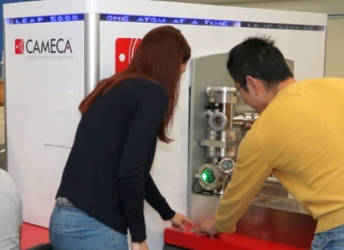
LEAP5000 - microanalysis one atom at a time
The Department of Materials at Oxford offers an exciting environment in which to work for a research degree. As a student on the DPhil in Materials or MSc (Research) in Materials programme you will be part of one of the top-ranked Materials
departments in the world. Leading-edge research is carried out across a wide range of materials science, from atomic-scale characterization, through state-of-the-art materials modelling, to pilot industrial-scale processing. Further information about our current research.
Our vibrant research school consists of around 33 academic staff, 13 Senior Research Fellows, and around 240 research students and 80 postdoctoral researchers. Our research students are of many nationalities and come to the department from diverse
scientific backgrounds. They are graduates in the traditional subjects of Materials Science, Physics, Chemistry and Engineering and also Mathematics, Earth Sciences and Biology.
The DPhil in Materials is normally carried out in three and a half to four years of full-time study under the supervision of an experienced member of staff. A wide range of exciting DPhil projects is available; including several on materials
for nuclear fusion reactors, and several on materials for solid state batteries. Details of the DPhil programme, including training opportunities (academic courses, research-specific skills and generic transferable career skills) and progression requirements,
can be found in the current version of the Materials Graduate Student Handbook (see link below, under 'Other Information').
Research interests of the Department extend over most branches of materials science, as well as some aspects of solid state physics and chemistry: they include the study of a wide range of materials of relevance in advanced technological applications,
including metals and alloys, composites, semiconductors, superconductors, polymers, biomaterials, ceramics and materials for quantum information processing. Much of the research is carried out in close collaboration with industry.
The Department's high rating for research is evidence of its excellence in a wide range of materials research. In the UK Government's most recent assessment of research excellence in UK universities, the 2021 REF, research from Oxford's Department of
Materials and its Department of Engineering Science was jointly submitted to REF Unit of Assessment (UOA) 12 - Engineering^. For this submission 71% of the research activity of the two departments was judged to be in the highest, Grade 4* ('World-leading'),
category of excellence and a further 26% as Grade 3* ('Internationally Excellent'). 90% of research impact was judged to be 'World-leading'. [^There is not a specific REF UOA for Materials.]
Research Students of the Department of Materials are also members of the University's Mathematical Physical and Life Sciences Division Graduate School which provides a wide range of
support and training.
AN INTERVIEW WITH ONE OF OUR RECENT DPHIL IN MATERIALS GRADUATES, SANMI ADEKANYE
https://www.youtube-nocookie.com/embed/zXohefnTFas?si=juhQemA27-wO5JVo'WELCOME TO OXFORD MATERIALS' VIDEO: A brief look at some of our laboratories and comments from four recent members of our Department
DPhil students - Colum and Shaz, Post-doc - Bo, and final year M.Eng in Materials Science UG student - Rachel
In addition to the videos above, you may find it helpful to view a 'Virtual Tour' of the Department, together with the other short videos and information available via the same webpage as the virtual tour.
RESEARCH PROJECTS AVAILABLE
We offer a wide range of exciting research projects, details of which can be found at Projects Available
Closing dates for receipt of applications
Until early March applications will be considered in three gathered fields, as advertised in the Oxford University Graduate Studies Prospectus. Deadlines for the receipt of fully completed applications and references are noon (UK time) on: 10 November
2023, 19 January 2024 and 1 March 2024. Applications received after 1 March will be considered on an individual basis soon after receipt.
How to Apply
If you wish to apply to the Department, you will need to complete the standard Oxford University Graduate Application Form, which can be found via the University’s Graduate Admissions Application Guide.
Having first carefully read the information (i) on the present webpage, (ii) on our projects available webpage and (iii) in the University's application guide you should apply using the online application form. If you have a problem with using the
online form, please contact the Graduate Admissions Office as indicated in the Application Guide. To submit an application requires the payment of an application fee but, as detailed on the webpage, application fee waivers are available for applicants from low-income countries and for UK applicants from low-income backgrounds.
Further information about our research degree programmes
The following research degree programmes are offered by the Department of Materials, further information being available through the weblinks provided:
DPhil in Materials A three-year to four-year Doctoral programme, known as a PhD elsewhere, for which approximately fifty-seven places may be available.
MSc (by Research) in Materials A two-year research Masters programme, for which only one or two places may be available.
You may be interested too in the following research degree programme:
Inorganic Materials for Advanced Manufacturing (DPhil) A four-year Doctoral programme hosted jointly by the Department of Chemistry
and the Department of Materials.
What about funding?
All applicants for the DPhil in Materials programme with at least a strong upper second class UK honours degree (or equivalent) in a relevant subject (primarily Materials, Chemistry, Physics or Engineering) are considered for our fully-funded Engineering & Physical Sciences Research Council (EPSRC) studentships.
In addition you are eligible for a number of scholarships administered by the University. Full information about these schemes is available in the Graduate Studies Prospectus.
Some of the individual projects described on the Oxford Materials website carry secured earmarked funding and in these cases the eligibility of Home and International students is indicated. Typically these projects are funded by one or more of the
following: EPSRC, EC, Industry, Private Donation, and UK Government.
[The classifications above, of ‘Home' and ‘International’, are set by the University in accordance with UKCISA guidance.]
College Choice
All research students are members of a college (further information on colleges). On the graduate application form, you may choose either (i) to indicate that you have no college preference,
in which case a college will be selected on your behalf, or (ii) to state a college preference. You will not be able to amend your choice after submitting your application. Whether or not you state a college preference will not affect the Department's
assessment of your application. You can find out which colleges accept Materials research students at the 'College Preference' tab of the relevant course page (www.ox.ac.uk/admissions/graduate/courses/mpls/materials).
Why become a DPhil student at Oxford Materials?
A large majority of our DPhil graduates find employment when they finish: an Oxford DPhil is valued by employers across the world. Some of our DPhil graduates enter industrial research, some the business, finance and government sectors, others go into
university careers both in the UK and overseas, and still others pursue challenging jobs as, for example, patent agents, or consultants.
See what some of our recent graduate students say about this, and what they have gone on to do after their DPhil:


‘The 3-year DPhil study in Oxford has been a fantastic experience for me. The Department of Materials has provided me the chance to access state-of-the-art research facilities, with the professional guidance and support from both academic and technical staff in the department. I have had great opportunities to work alongside brilliant colleagues and collaborators on various exciting projects, publish work in high-impact journals, and with the support of the department and college, present those work in international scientific conferences. All of these experiences have laid a strong foundation for my future academic career. Positioned right beside the beautiful University Park, my departmental office and lab offer a pleasing and comfortable working environment. Other than exploring in the world of science, the department and college have also provided me with a wonderful extracurricular life.’

‘I studied Physics at Durham University and applied to Oxford Materials to pursue an exciting project supervised by very distinguished academics. I had a fantastic time! I was encouraged to pursue the research by following my own intuition, whilst being guided at every stage by dedicated supervisors. At my disposal was a well-integrated network of world experts to turn to for help, and the entire university’s array of measurement facilities, both of which allowed me to perform world class research. I had a different living arrangement to most, living outside of Oxford and commuting in by train. I treated the DPhil very much like a job in terms of my daily schedule, which was very manageable and gave me a good work/life balance. After graduating I joined one of Oxford’s many scientific start-up companies and have a stimulating engineering job out there in ‘the big wide world’. The analytic skills I learned at Oxford serve me well every day.’

‘I graduated with a Physics degree from the University of Bucharest in Romania and I wanted to pursue a doctoral degree in computational materials modelling – I knew that Oxford Materials had a long-standing reputation and tradition of world class research in this field, so I applied for a DPhil and joined the Department in Sept 2011. After graduation I stayed on as a PDRA until Sept 2018, when I moved to the US for a second postdoc at UC Berkeley and Lawrence Berkeley National Lab. In February 2020 I joined the faculty of the Department of Physics here in Oxford as an Associate Professor of Condensed Matter Physics and University College as a Tutorial Fellow. My time as a DPhil student and PDRA in the Materials Department was transformational – I had numerous opportunities to not only grow as a scientist and academic but also to develop important personal and professional skills that have helped my career since. As a graduate student and PDRA I was able to gain valuable research and teaching experience, I participated in scientific seminars given by speakers from all over the world, and I was able to participate in career development events that broadened my perspective on all the possible career routes I could pursue. My main advice to prospective students is to be open to opportunities coming their way – they will be numerous, challenging, and very exciting!’

'I applied to Oxford Materials because it has an outstanding research environment. The people at Oxford motivated me in my work every day, I was blessed to be surrounded with so many brilliant minds who were also so generous in helping others. The department provided graduate students with excellent training of hands-on access to state-of-the-art research facilities as well as personal development. As a graduate student, I was enrolled at Trinity College. The highlight of college life was again meeting with students from all over the world and who were studying so many different interesting subjects. For new students, it might be overwhelming at the beginning. Please embrace and enjoy all the new things that you experience, you would soon get used to the life at Oxford and have a rewarding time!’

‘I studied physics and chemistry at University College Utrecht (Utrecht University, the Netherlands), followed by a masters in nanomaterials physics at Utrecht University. I applied to the Department of Materials to continue doing exciting research and to experience doing research at a different University, in a different country. I like how diverse the research in the department is, bringing together physics, chemistry, materials science, and engineering, not just in different projects spread across the department, but often within a single project. Graduate students at the department also have the opportunity to present their work at international conferences and to gain teaching experience. Oxford has a vibrant student community and offers a large range of social and sports activities. During my DPhil I rowed for my college boat club as well as the Oxford University Women’s Boat Club, with the 2016 Boat Race as a highlight.’

‘I studied for a DPhil in Materials having completed my undergraduate degree in Physics, joining the materials modelling group. After completing my DPhil I worked as a postdoctoral researcher in Copenhagen and Warwick, and then re-joined the Department in 2019 as a departmental lecturer. In my current job I get to mix teaching with research into the fundamental properties of materials using computational methods. I still find it remarkable that so much of a material's behaviour can be understood using equations I first met as an undergraduate, and applying these to new materials can often throw up surprises. I found the Department a very stimulating place to do my DPhil, being surrounded by so much interesting research in varying fields. My reason to apply was driven by the opportunity to work with world-leading researchers. The Oxford college system also ensures you get to mix with fellow students in totally different subjects and disciplines. Having now sat on both sides of the fence (as it were) I also appreciate the efforts that the Department goes to support its graduates through the supervision system. I spent a lot of my free time doing musical activities, but my DPhil was also the time when I started getting involved in outreach work, which is something I've continued to enjoy over my career. In terms of surroundings, Oxford remains my favourite city of all the places I have lived, thanks to its atmosphere, green spaces, history and culture.’

‘At One Drop I am working on the development of a multiplex continuous biosensor to detect biomarkers related to diabetes, heart health and others. I am motivated by the desire to solve the current technological limitations in healthcare concerning the recognition, diagnosis and management of health issues, and the complex scientific challenges that come with that goal. Post-PhD I joined Flux Biosciences in San Francisco from July 2019 - July 2021 as Senior Scientist where I developed magnetic nanoparticle based biosensors for point-of-care detection of multiple biomarkers. I applied to Oxford Materials because of the quality of research, and the comprehensive equipment and resources available (e.g. an atomic resolution electron microscope). Whilst I was doing my PhD I was also involved in entrepreneurial activities at the Launchpad (now the Oxford Foundry), co-founding UPROSA, a retail start-up creating tech accessories from microscopy images. There is a support system at both the department and your college should things not go according to plan, and the weekly coffee morning really is a highlight and good resource for you to get to know others outside of your research group.’
‘I studied Physics at the University of St Andrews and joined Oxford Materials in 2016 for my DPhil. I worked on a really multi-disciplinary project, which came with the opportunity to work with some brilliant collaborators both in and outside the Department. I also got to present my research at several big international conferences, supported by Materials and my College. I would encourage anyone thinking about applying to Oxford to come with an open mind about what they want to work on - your DPhil will inevitably evolve in unexpected ways, but that’s the best part! I was incredibly lucky to work with a fantastic supervisor, who let me pursue my own interests while always being available to provide invaluable guidance and scientific input. I am now working as a post-doc on a related project and use the skills and training I received during my DPhil every day in my research.’

Dr Phani Karamched
‘I studied for a DPhil in Oxford Materials from 2007-2011 after having completed an undergraduate degree of Metallurgy and Materials in India. During this time, I was enrolled at Corpus Christi College and was involved in organising cultural and sporting events for several student clubs across the university. Having finished my degree at Oxford, I worked for 6 years in India in the Defence aerospace sector and a steel industry. I returned to work at the Oxford Materials Department in 2016 as a postdoctoral researcher to understand how engineering materials fail in their working environment. With guidance from outstanding academics and technical staff, I constantly work on developing newer testing procedures that add to a better understanding of materials. Both as a student and staff, I have always felt safe and included at Oxford. The support system within the Department (and University) made sure that I was never neglected. My advice to new and prospective students would be to come with an open mindset to meet new people and always ask lots of questions. ’

Dr Ruth Jones
‘I started my DPhil in autumn of 2016 after graduating from the University of Leicester with a degree in Interdisciplinary Science. At the time when I was applying for Oxford Materials, I had three things in mind: intellectually stimulating environment, great facilities and promising career prospects. After experiencing 4 years of graduate life, I can safely say that my ‘reasons to apply’ checklist was pretty accurate; now, I would also add beautiful city and fulfilling college life. Here’s my comment about the overall Oxford experience that is relevant to the Department itself- there’s always a lot going on! There’s such a wide range of research at Materials and there are many opportunities to learn about what’s happening in other groups (also from other departments) through events such as colloquia and student presentations. Importantly, although everyone is busy, the people of the Department are usually very willing to help whenever approached, e.g. regarding training, advice or collaborating. The Oxford college system or flourishing society-scape also offer many opportunities to learn and develop yourself in one way or another. During my DPhil, I volunteered at the Science Innovation Union, a graduate-founded platform, as their Editor in Chief. This role worked alongside my DPhil in honing my written communication skills, which are especially valuable and transferable to my current position as a trainee patent attorney at Hoffmann Eitle in London. ’
Dr Alex Leide
'I was a DPhil student in the Department of Materials between 2015 and 2019 on the Fusion Centre for Doctoral Training. Straight after submitting my thesis I stayed in Oxford for 4 months as a postdoc researching ceramic bulletproof armour, and now I am a research associate at the University of Bristol researching nuclear fuels. It is really satisfying seeing my research contributing to the design of new nuclear reactors and decarbonising energy. My DPhil training in Oxford prepared me well in the technical skills for my current job, but also in soft skills like project management, communication, and collaboration which are transferrable to any career. You learn far more than just science, and there are countless training courses you can take in the University such as entrepreneurship or languages. I also took on some paid teaching roles including tutoring undergraduate students which is highly rewarding. There are excellent opportunities during a DPhil in Oxford Materials, including travelling to various conferences around the world, and my personal highlight was a three-month research visit to Tokyo Institute of Technology. The research facilities in the department are world class, and if you have an idea for an experiment there are excellent people to help you make it happen. Oxford is a really diverse city, and I highly valued joining local cycling clubs and living with people who weren’t students so you get a wider exposure to non-university life.'
Other Information
The Materials Graduate Student Handbook
Training available to members of the MPLSD Graduate School
Summary of Provision for Materials Research Students
A Guide to the Supervision of Research Students
DETAILED GUIDANCE AND HOW TO APPLY
UK and Republic of Ireland Applicants

International Applicants (Includes EU applicants)
Admissions Criteria
Graduate Admissions Entry Requirements and Selection Criteria for the Department of Materials
UNIQ+ Research Internships for Undergraduates
Applications are now open for the University's 2024 UNIQ+ research internships
These internships are designed to provide students from under-represented and disadvantaged backgrounds who are ordinarily resident in the UK with the opportunity gain insight into postgraduate-level study at Oxford. UNIQ+ gives students the chance to experience life as a graduate student at Oxford, gaining skills and experience that we hope will enhance both their CV and any future applications for postgraduate study. During the seven-week programme, which will run from Monday 1 July to Friday 16 August 2024, students will undertake a research project, attend training and information sessions, and have the opportunity to take part in social events.
Applications close at 12:00 midday UK time on Wednesday 21 February 2024. For full eligibility criteria, the full list of available research projects and to apply, visit https://www.ox.ac.uk/admissions/graduate/access/uniq-plus/about
Equality, Diversity & Inclusion
The Department of Materials is a diverse community that is fully committed to promoting equality in all activities, including in post-graduate recruitment. We encourage potential applicants to consider the supportive nature of the working environment that we offer. Find out more about EDI within the University and its Department of Materials respectively at: Oxford University EDI and Oxford Materials EDI .

